Primary 1 Malay Books Singapore 2026 | Darjah 1 Guide


🎓 Ready to Excel in Your Studies?
Join thousands of students who have improved their grades with EduReach's proven teaching methods. Start your journey to academic success today!
Enroll Now via WhatsAppStarting Primary 1 marks a significant transition in your child's education journey. While schools provide textbooks and classroom instruction, many parents discover that consistent home practice with quality assessment books makes the difference between struggling and thriving in Bahasa Melayu. For Primary 1 students, the right workbook builds foundational vocabulary, sentence construction skills, and oral confidence that set the stage for success throughout primary school.
Understanding Primary 1 Malay Language Learning in Singapore
The Ministry of Education's Primary 1 Malay curriculum introduces children to formal language learning through thematic units. Schools typically use the Cita series as the core textbook, covering everyday topics like family, school, food, and animals. Lessons focus on three key areas: vocabulary acquisition (kosa kata), basic sentence formation (ayat mudah), and oral expression (unjuk ujar).
What Primary 1 Students Learn
First-year students work toward several concrete goals. They learn to recognize and write 200-300 common Malay words organized by theme. They practice arranging simple three-to-four-word sentences following basic subject-verb-object patterns. They also participate in show-and-tell activities where they describe pictures, answer questions, and share simple stories in Malay.
Unlike upper primary levels where composition writing and comprehension passages dominate, Darjah 1 emphasizes building blocks. Teachers prioritize correct pronunciation, proper word recognition, and comfortable oral participation. Written work remains limited to copying sentences, filling in single words, and writing very short responses.
The Role of Assessment Books
MOE textbooks introduce concepts, but assessment books provide the repetition children need to internalize new language patterns. A typical school textbook might present 20 vocabulary words with two practice exercises. An assessment book offers 50-100 practice questions on those same words, cycling through matching, fill-in-blanks, picture labeling, and sentence writing. This repetition transforms recognition into recall—children move from identifying "kucing" when they see a cat picture to independently writing "kucing" when needed.
Parents often ask whether assessment books are necessary if their child performs well in class. The answer depends on your goals. For maintaining adequate performance, school materials may suffice. For building mastery, confidence, and preparation for increasingly challenging upper primary content, supplementary practice becomes essential. Strong Primary 1 foundations directly impact Primary 5-6 PSLE preparation several years later.
Choosing Effective Primary 1 Malay Assessment Books
Quality assessment books share several characteristics that distinguish them from workbooks that simply add busywork to your child's schedule.
Current syllabus alignment ensures practice material matches what teachers cover in class. Books published recently and labeled "sukatan pelajaran terkini" reflect the latest curriculum. Using outdated workbooks creates confusion when question formats or terminology differ from school expectations.
Logical topic progression mirrors classroom teaching sequences. The best workbooks organize content into discrete sections—vocabulary, spelling, sentence work, writing—allowing focused practice rather than scattered exercises. This organization helps parents identify specific weak areas. If your child struggles with spelling but handles vocabulary well, you can concentrate on the Eja dan Baca section rather than randomly working through mixed exercises.
Oral practice inclusion separates comprehensive workbooks from writing-only resources. Many assessment books omit oral components entirely despite oral assessment contributing significantly to Primary 1 Malay grades. Books that include picture description prompts, conversation starters, and show-and-tell guidance provide home practice for skills otherwise only exercised in classroom settings.
Complete answer keys enable independent parent-guided practice. Without answers, parents cannot provide immediate feedback, and delayed correction allows errors to become habits. Clear answer keys also help parents who lack confidence in their own Malay language abilities to guide their children effectively.
Latihan Efektif Bahasa Melayu Berserta Unjuk Ujar Untuk Darjah 1 Edisi 2: Complete Analysis
The Latihan Efektif Bahasa Melayu Berserta Unjuk Ujar Untuk Darjah 1 Edisi 2 workbook represents a comprehensive approach to Primary 1 Malay practice. This book addresses all major skill areas while incorporating oral practice components often missing from competitor products.
Comprehensive Content Structure
The workbook divides into six main sections, each targeting specific skills aligned with MOE curriculum requirements.
Kosa Kata (Vocabulary) presents thematic word lists with progressive exercises. Children begin with picture-word matching, advance to spelling practice, and conclude with using new words in context. Themes include family members, school items, common foods, daily activities, animals, and basic descriptions. Each theme provides 15-25 core vocabulary words with supporting exercises that spiral from recognition through independent recall.
The vocabulary section includes both nouns (naming words) and basic adjectives (describing words), introducing children to word categories they'll encounter throughout primary education. For example, the food theme teaches not just "nasi" (rice) and "ikan" (fish) but also "sedap" (delicious) and "panas" (hot), building descriptive vocabulary from the start.
Eja dan Baca (Spelling and Reading) develops phonetic awareness and spelling accuracy. Malay follows relatively consistent phonetic rules compared to English, making systematic practice highly effective. Exercises present word families that share patterns—"baca, buka, bina" or "makan, masak, main"—helping children recognize recurring structures that make spelling predictable rather than arbitrary.
Reading exercises progress from single words to short phrases to simple sentences. Early exercises might ask children to read "Ini buku" (This is a book) while later pages present "Adik saya suka membaca buku cerita" (My younger sibling likes reading story books). This gradual complexity building ensures children don't face overwhelming jumps in difficulty.
Susun Ayat (Sentence Construction) teaches proper Malay word order through jumbled word exercises. Children receive three to five words and arrange them into grammatically correct sentences. Starting with simple subject-verb-object patterns like "Saya / makan / nasi" (I / eat / rice), exercises gradually incorporate time words, location words, and descriptive words.
This section proves particularly valuable because word order differs between Malay and English. English speakers say "red car" while Malay speakers say "kereta merah" (car red). Early practice with correct Malay patterns prevents interference from English language structures children encounter outside Malay class.
Latihan Tulisan (Writing Practice) moves beyond copying to independent writing. Exercises include completing partial sentences, answering simple questions with short written responses, and writing two-to-three-sentence descriptions of pictures. The scaffolding approach provides substantial support initially—sentence starters, word banks, guided questions—then gradually reduces support as children build confidence.
Writing practice at Primary 1 establishes habits that impact later composition work. Children learn to write complete sentences with proper capitalization and punctuation. They practice reading questions carefully before answering. They develop the habit of checking their work for basic errors. These foundational practices become automatic behaviors that support the more complex writing required in Primary 3 and beyond.
Peluasan Ayat (Sentence Expansion) introduces basic descriptive enhancement. Children start with simple statements like "Ini kucing" (This is a cat) and practice adding descriptive words: "Ini kucing comel" (This is a cute cat) or "Ini kucing putih" (This is a white cat). Later exercises encourage adding both descriptions and actions: "Kucing comel itu sedang bermain" (That cute cat is playing).
Sentence expansion skills directly support the detailed descriptions teachers expect in upper primary compositions. Children who practice expansion early find it natural to write "Saya pergi ke pasar malam yang ramai dengan keluarga saya pada petang Sabtu" rather than writing choppy basic sentences: "Saya pergi pasar. Pasar ramai. Saya pergi dengan keluarga."
The Unjuk Ujar Advantage
The Unjuk Ujar (Oral Practice) section distinguishes this workbook from most Primary 1 assessment books. Oral assessment represents 20-30% of Primary 1 Malay evaluation, yet most assessment books provide zero oral practice materials. Parents struggle to prepare children for show-and-tell, picture descriptions, and teacher conversations without structured guidance.
The Unjuk Ujar section provides picture prompts with suggested talking points. For example, a family picture might include prompts like "Who are the people in the picture?", "What are they doing?", "Where are they?", and "How do they feel?". These guided questions help parents conduct practice sessions at home, building children's confidence with oral Malay in a low-pressure environment.
Oral practice at home offers several advantages over classroom-only speaking. Children who freeze during class presentations often speak comfortably at home where only family listens. Repeated home practice transforms show-and-tell from anxiety-inducing performance to familiar routine. Parents can record practice sessions, allowing children to review their own performances and notice areas for improvement—hesitations, forgotten words, or unclear pronunciation.
The oral component also helps non-Malay-speaking families engage with their child's language learning. Even parents who don't speak Malay fluently can facilitate oral practice by asking the guided questions and encouraging their child to speak, building the comfort and fluency that classroom time alone cannot develop.
Updated Second Edition Features
As the second edition, this workbook incorporates refinements based on teacher and parent feedback. Updated editions typically clarify confusing instructions, adjust exercise difficulty based on actual student performance data, and ensure alignment with current examination formats. Small improvements—clearer font sizes, better picture quality, more intuitive page layouts—collectively enhance user experience and learning effectiveness.
The complete Kunci Jawapan (Answer Key) section enables parents to facilitate independent study routines. Children complete exercises during designated practice time, then review answers with parents in the evening. This approach builds self-directed learning habits while ensuring parental involvement in academic monitoring. Parents can quickly identify patterns in errors—consistent spelling mistakes, sentence structure confusion—and address them before they become ingrained habits.
Pricing and Availability
Primary 1 Malay assessment books in Singapore typically range from $12.90 to $21.90 depending on publisher, page count, and included features. The Latihan Efektif Bahasa Melayu Berserta Unjuk Ujar Untuk Darjah 1 Edisi 2 is priced at $12.90, making it one of the most affordable comprehensive workbooks available. Given that a single comprehensive workbook supports an entire academic year of supplementary practice, this represents exceptional value compared to weekly tuition classes that can cost $200-400 monthly.
Building Foundations: Pre-Primary Preparation and Progression Planning
While quality assessment books form the core of Primary 1 home practice, some children benefit from additional resources, particularly those from non-Malay-speaking households or those needing foundational support before formal primary learning begins.
Preschool Preparation Resources
For families with children approaching Primary 1, or younger siblings who want to learn alongside their older brother or sister, the KidzNizmo series provides age-appropriate Malay language introduction. These resources use storytelling, games, and colorful illustrations to introduce basic vocabulary and simple phrases without the pressure of formal academic expectations.
Kembara KidzNizmo (Edisi Khas KidzNizmo) Prasekolah 1 ($16.90) serves children ages 4-6 who need gentle introduction to Malay before primary school begins. The workbook uses familiar preschool themes—colors, shapes, animals, family—to build a foundational 50-100 word vocabulary. Activities include coloring, matching, and simple tracing that feel like play rather than formal study.
KidzNizmo Episode 1, Episode 2, and Episode 3 provide progressive learning across the preschool years. Episode 1 introduces absolute basics for youngest preschoolers, while Episodes 2 and 3 gradually increase complexity, preparing children for the Primary 1 transition. This three-book progression ensures appropriate difficulty at each developmental stage rather than expecting all preschoolers to work at the same level. Parents can also purchase the KidzNizmo Bookset ($29.00) for comprehensive preschool coverage.
Starting with preschool materials proves particularly beneficial for children from English-speaking households. When Malay instruction begins in Primary 1, children from Malay-speaking families arrive with conversational fluency developed through daily home language exposure. Children without this background face significant disadvantage without intentional preparation. Building even a small vocabulary base before Primary 1 reduces first-year stress and helps children maintain pace with peers who have home language advantages.
Primary 2 and Beyond: Continuing the Journey
As children master Darjah 1 content, natural progression continues with Latihan Efektif Bahasa Melayu Berserta Unjuk Ujar Untuk Darjah 2 Edisi 2. Using the same workbook series across primary years maintains consistency in format and approach. Children focus on increasingly complex content rather than adapting to new workbook structures, exercise types, and instruction styles each year.
The Latihan Efektif series provides comprehensive workbooks for every primary level:
Lower Primary (Unjuk Ujar Focus):
-
Latihan Efektif Bahasa Melayu Berserta Unjuk Ujar Untuk Darjah 1 Edisi 2
-
Latihan Efektif Bahasa Melayu Berserta Unjuk Ujar Untuk Darjah 2 Edisi 2
Upper Primary (Panduan Lisan Focus):
-
Latihan Efektif Bahasa Melayu Berserta Panduan Lisan Untuk Darjah 3 Edisi 2
-
Latihan Efektif Bahasa Melayu Berserta Panduan Lisan Untuk Darjah 4 Edisi 2
-
Latihan Efektif Bahasa Melayu Berserta Panduan Lisan Untuk Darjah 5
-
Latihan Efektif Bahasa Melayu Berserta Panduan Lisan Untuk Darjah 6
Note that Darjah 1 and 2 books feature Unjuk Ujar (show-and-tell/basic oral) sections, while Darjah 3-6 books include Panduan Lisan (oral examination guides) reflecting the more formal oral examination formats in upper primary.
For parents who plan ahead, understanding the long-term pathway helps inform current practice decisions. While Primary 1-4 build foundations through the Latihan Efektif series, Primary 5-6 require intensive PSLE preparation using specialized resources:
PSLE Preparation Books:
-
Latihan Topikal Bahasa Melayu Untuk Persiapan PSLE Untuk Darjah 5 & 6 - Topic-focused drilling covering all PSLE question types
-
Latihan Efektif Bahasa Melayu Lanjutan Untuk Darjah 5 & 6 - Advanced exercises for high-performing students
The vocabulary acquisition, sentence construction habits, and writing foundations established during Primary 1 practice sessions directly impact PSLE performance four to five years later. Children who build strong fundamentals early approach upper primary with confidence and competence, while those with weak foundations struggle increasingly as content complexity accelerates.
Composition Writing Development
As children progress beyond Primary 2, composition writing (karangan) becomes increasingly important. EduReach offers specialized composition books for upper primary:
-
Koleksi Karangan serta Panduan Mengarang Darjah 3
-
Koleksi Karangan serta Panduan Mengarang Darjah 4
-
Koleksi Karangan serta Panduan Mengarang Darjah 5
-
Koleksi Karangan serta Panduan Mengarang Darjah 6
These composition-focused books complement the Latihan Efektif series by providing model essays, writing frameworks, and guided practice specifically for karangan development—skills that begin with the sentence expansion exercises in Primary 1-2 workbooks.
Maximizing Assessment Book Effectiveness: Practical Implementation Strategies
Purchasing an assessment book represents only the first step. How parents structure practice sessions determines whether the workbook delivers learning gains or simply adds busywork to your child's already-full schedule.
Creating Sustainable Practice Routines
Primary 1 children have limited attention spans and energy reserves after full school days. Rather than attempting lengthy study marathons, establish 15-20 minute daily practice sessions during times when your child demonstrates peak alertness. For most children, this optimal window occurs shortly after returning home, having a snack, and decompressing for 20-30 minutes—not immediately after school when they're exhausted or late evening when they're preparing for bed.
Structure weekly practice with rotating focus areas rather than attempting comprehensive coverage daily. Consider this sample schedule:
Monday and Wednesday: Vocabulary and spelling practice using the Kosa Kata and Eja dan Baca sections. Complete 1-2 pages focusing on current school themes.
Tuesday and Thursday: Sentence construction and expansion work through Susun Ayat and Peluasan Ayat exercises. Aim for 10-15 sentences arranged or expanded.
Friday: Oral practice using the Unjuk Ujar section. Spend the full 15-20 minutes on speaking rather than writing, with parents asking questions and children responding in Malay.
This focused approach allows deeper engagement with each skill type rather than superficial coverage of everything. Children develop mastery through concentrated practice rather than scattered attempts.
Weekend practice should remain optional except when children are genuinely behind or preparing for specific assessments. Primary 1 students need unstructured play time for cognitive development, social skill building, and creative exploration. Converting weekends into extended study sessions often creates negative associations with learning that backfire in later years when intrinsic motivation becomes increasingly important.
Strategic Exercise Selection and Pacing
Parents don't need to complete every exercise in sequence from page one to the final page. Assessment books provide comprehensive practice libraries, not mandatory curricula requiring 100% completion.
Begin each new topic by assessing your child's current level. If they confidently complete the first two or three exercises in a section with minimal errors (80%+ accuracy), skip ahead to more challenging exercises in that section. Drilling mastered concepts wastes limited practice time and risks boring children, creating resistance to future practice sessions.
Conversely, when particular skills prove challenging, slow down significantly. Complete additional exercises in that specific area, even repeating similar exercise types if necessary. Consider creating supplementary practice using the same patterns. If your child struggles with sentence construction in the Susun Ayat section, write additional sentence-arranging activities using vocabulary from their school textbook before advancing to the next workbook section.
Use assessment books diagnostically to identify patterns in errors. When children make consistent mistakes in specific areas—plural forms, verb usage, specific vocabulary categories—note these patterns. Share observations with your child's teacher or tuition instructor, who can provide targeted instruction addressing the root confusion rather than simply correcting individual errors.
Track progress through simple record-keeping. Note which pages you complete each week, along with your child's approximate accuracy and confidence level. After 6-8 weeks, review your records to assess whether practice is yielding improvement. If you observe no progress despite consistent effort, professional tuition may be necessary to address underlying comprehension issues that practice alone cannot resolve.
Making Oral Practice Natural and Engaging
The Unjuk Ujar component requires different approaches than written exercises. Formal recitation often creates anxiety that defeats the purpose of building oral confidence.
Integrate oral practice into daily routines rather than treating it as isolated academic work. During dinner, ask your child to describe their day in Malay using simple sentences. While driving, play "describe what you see" games where children practice vocabulary in natural contexts: "Saya nampak kereta merah" (I see a red car), "Itu adalah bangunan tinggi" (That is a tall building).
When using the structured Unjuk Ujar section, create low-pressure environments. Sit side-by-side looking at the picture together rather than positioning yourself across the table in teacher-like configuration. Ask the guided questions conversationally rather than in quiz format. Accept all attempts positively, then model better phrasing: "Yes, that's a cat! Can you tell me what color the cat is? You could say 'Kucing itu berwarna putih.'"
Record practice sessions using your phone's voice recorder or video. Children often find reviewing their own recordings revelatory—they notice their own hesitations, vocabulary gaps, or pronunciation issues that they don't recognize in real-time. Recordings also document progress over time, which provides motivation when children feel discouraged about their improvement pace.
If you speak Malay fluently, model good oral language naturally during practice. However, parents who don't speak Malay shouldn't avoid oral practice. Children receive native speaker exposure through teachers; your role involves encouraging practice rather than providing perfect pronunciation modeling. Focus on building comfort and fluency; teachers address pronunciation refinement during classroom instruction.
Consider involving Malay-speaking relatives, neighbors, or family friends for occasional conversation practice. Brief 10-15 minute conversations with different adults build children's confidence speaking Malay with varied audiences, not just parents and teachers. This exposure helps children generalize their language skills rather than developing classroom-only or parent-only Malay proficiency.
Integrating Assessment Books with School Learning
Assessment books should complement and reinforce school instruction, not race ahead or duplicate homework.
Review what your child currently learns in school and practice related concepts from the assessment book. If their teacher is teaching family vocabulary this week, complete the family vocabulary section in the Kosa Kata pages. This reinforcement approach strengthens current learning rather than introducing new concepts that might confuse your child by conflicting with their teacher's instructional sequence.
Check your child's school textbook and homework regularly to identify areas where they struggle. If errors appear consistently in school work—specific vocabulary confusion, particular grammar mistakes—target those areas during assessment book practice. This strategic approach addresses actual weak points rather than blindly working through pages sequentially.
During school holiday periods, use assessment books differently. The March, June, September, and especially November-December breaks offer ideal windows for comprehensive review and advancement. Without competing school homework, children can complete practice exercises covering multiple earlier topics, consolidating learning and identifying any lingering weak areas.
The November-December break particularly warrants intensive practice. Complete a comprehensive review of the entire year's content before Primary 2 begins. This consolidation helps identify foundational gaps that can be addressed during the December holiday rather than becoming increasingly problematic throughout Primary 2.
Avoid practicing new, unreleased school content. While advancing might seem beneficial, it often creates confusion. Children struggle when home practice and school instruction present the same material differently. Trust teachers to introduce new concepts; use assessment books to reinforce, not replace, classroom instruction.
Frequently Asked Questions About Primary 1 Malay Assessment Books
When should I start using assessment books for my Primary 1 child?
Wait until after the first term concludes, typically around March or April. The first Primary 1 months involve substantial adjustment—learning school routines, making friends, adapting to formal learning structures, managing new schedules. Adding supplementary academic work too early often overwhelms children, creating negative associations with home study that persist throughout primary school.
Once your child has settled into school routines and established basic familiarity with classroom Malay instruction, assessment books become helpful reinforcement tools rather than additional stressors. Watch for signs of readiness: your child completes homework relatively independently, demonstrates interest in learning, and doesn't show signs of school-related anxiety or overwhelm.
My child is doing well in school—do we still need assessment books?
Yes, though for different reasons than struggling students need them. High-performing students benefit from assessment books that provide extension opportunities beyond basic classroom exercises. Without additional challenges, strong students risk boredom and may develop poor learning habits—minimal effort for adequate results—that become problematic when content difficulty increases in upper primary.
Assessment books help strong students deepen understanding rather than maintaining surface-level competence. Mastery requires practice volume beyond what school provides. Additionally, building robust practice habits early establishes routines that become crucial during Primary 5-6 PSLE preparation when expectations increase dramatically. Children who suddenly face intensive study requirements in Primary 5 often struggle with habit formation; those with established Primary 1-4 routines transition smoothly to PSLE demands.
Consider using assessment books selectively for high performers. Rather than completing every page, focus on challenging sections that extend beyond school content while skipping repetitive drilling of already-mastered skills.
How do Latihan Efektif and Latihan Topikal books differ?
Latihan Efektif workbooks provide comprehensive year-long practice covering all skill areas—vocabulary (Kosa Kata), spelling and reading (Eja dan Baca), sentence construction (Susun Ayat), writing practice (Latihan Tulisan), sentence expansion (Peluasan Ayat), and oral practice (Unjuk Ujar for Darjah 1-2, or Panduan Lisan for Darjah 3-6). These books suit Primary 1-6 regular practice, building foundations systematically across all language components.
Latihan Topikal Bahasa Melayu Untuk Persiapan PSLE Untuk Darjah 5 & 6 offers intensive, topic-focused examination drilling designed specifically for PSLE preparation. Rather than comprehensive skill building, it concentrates on specific content areas tested on PSLE—comprehension passages, cloze passages, grammar questions, composition writing. Exercises follow PSLE formats and difficulty levels.
Use Latihan Efektif during all primary years (1-6) for comprehensive practice. Add Latihan Topikal during Primary 5-6 for focused examination preparation alongside your regular Latihan Efektif books. The two series complement rather than replace each other during PSLE years.
What's the difference between MOE textbooks and assessment books?
MOE-approved textbooks like the Cita series teach concepts through lessons, stories, dialogues, and limited practice exercises. They introduce new vocabulary, model sentence patterns, present grammar rules, and provide initial practice opportunities. However, textbook exercise quantity remains insufficient for mastery.
Assessment books like Latihan Efektif provide intensive practice through repetitive exercises that reinforce textbook-taught concepts. They offer 5-10 times more practice questions than textbooks, cycling through varied exercise formats that develop automaticity rather than just recognition.
Think of textbooks as introducing the "what" and "why" of language learning—what words mean, why sentences follow certain patterns—while assessment books provide the "how much" necessary for mastery—how many repetitions students need to internalize new language patterns into automatic usage.
Where can I buy Primary 1 Malay assessment books in Singapore?
Multiple purchase channels exist. School bookshops typically stock popular titles during January-February beginning-of-year period, though selection may be limited. Educational retailers including Popular, Times, and Fairfield Books maintain comprehensive assessment book sections year-round.
Online platforms provide convenient browsing and home delivery. EduReach Singapore carries the complete Latihan Efektif series (Darjah 1-6), KidzNizmo preschool resources, Latihan Topikal PSLE books, Koleksi Karangan composition books, and Latihan Intensif secondary level materials at edureachsg.com/collections/all. E-commerce platforms like Shopee and Lazada also carry assessment books, often at competitive prices, though shipping times may vary.
When purchasing, verify you're selecting the correct level and latest edition. "Darjah 1" and "Primary 1" refer to the same level. "Edisi 2" indicates second edition with updated content. Ensure books specify "latest syllabus" or recent publication dates for current curriculum alignment.
Is the Unjuk Ujar oral component really necessary for Primary 1?
Absolutely essential. Oral assessment contributes 20-30% of Primary 1 Malay evaluation, yet many children receive minimal oral practice at home. Schools conduct show-and-tell presentations, picture descriptions, teacher-student conversations, and group discussions that require comfortable oral Malay usage.
Children from non-Malay-speaking households particularly benefit from structured oral practice. Without daily home language exposure, they rely entirely on school for speaking practice—typically 30-40 minutes daily divided among 30+ classmates. This limited individual speaking time proves insufficient for building fluency and confidence.
The Latihan Efektif Bahasa Melayu Berserta Unjuk Ujar Untuk Darjah 1 Edisi 2 and Darjah 2 Edisi 2 specifically include Unjuk Ujar sections designed for Primary 1-2 oral practice. Parents receive guidance on what questions to ask, how to prompt descriptions, and how to encourage elaboration. This support proves invaluable for families unsure how to facilitate oral practice effectively.
Early oral confidence prevents anxiety that can develop when children focus exclusively on written work while feeling unprepared for speaking assessments. Children who practice speaking regularly at home view oral assessments as routine rather than stressful performances.
How many assessment books does my Primary 1 child need?
One comprehensive assessment book like Latihan Efektif Bahasa Melayu Berserta Unjuk Ujar Untuk Darjah 1 Edisi 2 typically provides sufficient practice for most Primary 1 students when used consistently throughout the year. The book contains comprehensive coverage of all major skill areas with multiple exercises per concept.
Purchasing multiple assessment books often results in incomplete usage of each. Parents feel overwhelmed by volume, children resist excessive practice, and books remain partially completed—creating more clutter than value.
Exception cases warrant additional materials. Children requiring intensive remedial work might benefit from supplementary resources alongside the comprehensive Latihan Efektif book. Those from non-Malay-speaking backgrounds needing foundation building could start with KidzNizmo Episode 1, 2, or 3 before moving to the Primary 1 workbook. However, most children succeed with one quality comprehensive resource used thoroughly.
Focus on completing one resource well rather than partially completing several. Better to finish 80-90% of one excellent book than 30-40% of three average books.
Should I hire a tuition teacher or can assessment books be enough?
Assessment books provide practice material but not instruction. This distinction determines what works for your child.
If your child understands concepts taught in school and simply needs reinforcement and repetition, home practice with assessment books under parental guidance often suffices. Signs that self-directed practice works include: your child completes school homework relatively independently, understands instructions without extensive explanation, makes gradual improvement over time, and demonstrates growing confidence with Malay.
However, if your child struggles to understand new concepts, professional tuition provides instructional support that assessment books cannot deliver. Warning signs include: frequent confusion about homework despite your explanations, consistent errors on similar question types even after correction, growing anxiety about Malay class, or teacher feedback indicating your child lags behind classmates.
EduReach Singapore offers both assessment book resources and professional Malay tuition services, allowing families to start with self-directed practice and add instructional support if needs arise. This flexible approach prevents over-tutoring while ensuring help is available when genuinely necessary.
Consider starting with assessment book practice for the first term. If your child shows signs of struggle despite consistent practice, add tuition during Term 2. This staged approach prevents premature tutoring while ensuring timely intervention when actually needed.
Making the Right Choice for Your Primary 1 Child's Malay Language Journey
Selecting appropriate assessment materials for your Primary 1 child establishes foundations for their entire primary school Malay language experience. The Latihan Efektif Bahasa Melayu Berserta Unjuk Ujar Untuk Darjah 1 Edisi 2 offers comprehensive coverage of essential Primary 1 skills while including the oral practice component that many competing books overlook.
The book's structured organization—distinct sections for vocabulary (Kosa Kata), spelling and reading (Eja dan Baca), sentence construction (Susun Ayat), writing practice (Latihan Tulisan), sentence expansion (Peluasan Ayat), and oral practice (Unjuk Ujar)—aligns with MOE curriculum requirements while providing the varied, repetitive practice young learners need to build both confidence and competence.
For children needing gentler preparation before tackling Primary 1 materials, beginning with KidzNizmo preschool resources creates appropriate entry points that prevent overwhelm and build positive associations with Malay language learning. The Kembara KidzNizmo (Edisi Khas KidzNizmo) Prasekolah 1, along with KidzNizmo Episodes 1, 2, and 3, provides age-appropriate vocabulary building for preschoolers approaching Primary 1.
For families planning ahead, remember that today's vocabulary acquisition and sentence construction practice directly impacts PSLE performance four to five years later. Children who build strong Primary 1-2 foundations through Latihan Efektif Darjah 1 and 2 approach Primary 3-4 with confidence. Those with solid Primary 1-4 groundwork transition smoothly to intensive Primary 5-6 PSLE preparation using Latihan Topikal Bahasa Melayu Untuk Persiapan PSLE Untuk Darjah 5 & 6 and Latihan Efektif Lanjutan.
As your child progresses through primary school, explore our complete guide to PSLE Malay Assessment Books for Primary 3-6 and specialized Latihan Topikal PSLE preparation strategies.
Assessment books represent an investment in your child's academic foundation, supporting school learning while building independent study habits that serve children throughout their educational journeys. Combined with consistent practice routines, appropriate parental involvement, and attention to both written and oral skills, quality assessment books become powerful tools for Primary 1 success and beyond.
Shop Primary 1 Malay Assessment Books at EduReach Singapore
Ready to support your child's Primary 1 Malay language development?
Primary 1-2 Books (Unjuk Ujar):
-
Latihan Efektif Bahasa Melayu Berserta Unjuk Ujar Untuk Darjah 1 Edisi 2 - $12.90
-
Latihan Efektif Bahasa Melayu Berserta Unjuk Ujar Untuk Darjah 2 Edisi 2
Preschool Preparation (Ages 4-6):
-
Kembara KidzNizmo (Edisi Khas KidzNizmo) Prasekolah 1 - $16.90
-
KidzNizmo Episode 1
-
KidzNizmo Episode 2
-
KidzNizmo Episode 3
-
KidzNizmo Bookset - $29.00 (complete set)
Primary 3-6 Books (Panduan Lisan):
-
Latihan Efektif Bahasa Melayu Berserta Panduan Lisan Untuk Darjah 3 Edisi 2
-
Latihan Efektif Bahasa Melayu Berserta Panduan Lisan Untuk Darjah 4 Edisi 2
-
Latihan Efektif Bahasa Melayu Berserta Panduan Lisan Untuk Darjah 5
-
Latihan Efektif Bahasa Melayu Berserta Panduan Lisan Untuk Darjah 6
PSLE Preparation (Primary 5-6):
-
Latihan Topikal Bahasa Melayu Untuk Persiapan PSLE Untuk Darjah 5 & 6
-
Latihan Efektif Bahasa Melayu Lanjutan Untuk Darjah 5 & 6
Composition Books (Primary 3-6):
-
Koleksi Karangan serta Panduan Mengarang Darjah 3
-
Koleksi Karangan serta Panduan Mengarang Darjah 4
-
Koleksi Karangan serta Panduan Mengarang Darjah 5
-
Koleksi Karangan serta Panduan Mengarang Darjah 6
Browse the complete Malay language book collection: edureachsg.com/collections/all
For children requiring additional instructional support beyond home practice, EduReach's experienced Malay language tutors provide personalized guidance that complements assessment book practice, ensuring no child falls behind during these crucial foundational years. Learn more about comprehensive Malay language support through our Malay Tuition & PSLE Guide.
About This Guide
This comprehensive guide was prepared by EduReach Singapore's education specialists with extensive experience in Primary-level Malay language instruction and curriculum development. For tuition inquiries, questions about selecting appropriate materials for your child's specific needs, or guidance on implementing effective home practice routines, visit edureachsg.com or contact EduReach Singapore directly.
Try Before You Commit!
Book a FREE trial class and experience our teaching excellence firsthand.
Need Personalized Guidance?
Speak with our education consultants to find the perfect program for your child.
Join the EduReach Family Today!
Be part of Singapore's most trusted tuition center with 4 convenient locations and personalized learning programs designed for your success.
💡 Free trial class available • No obligation • Flexible schedules
📚 Essential Education Books & Resources
Enhance learning with our curated selection of English, Math, and Science materials.
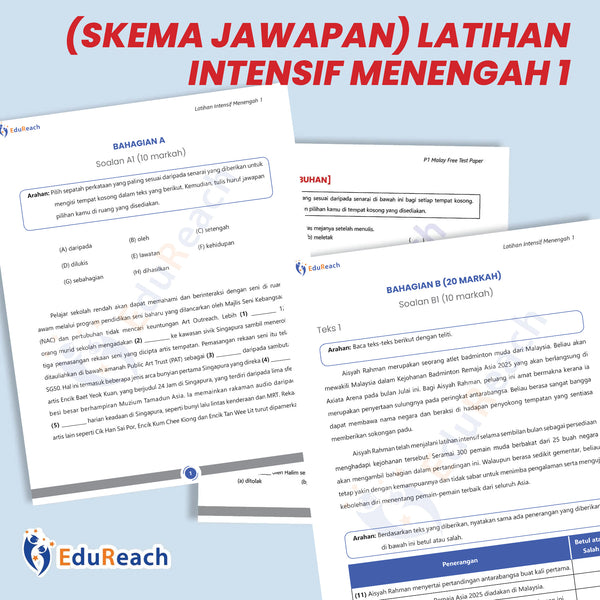
(Skema Jawapan) Latihan Intensif Menengah 1
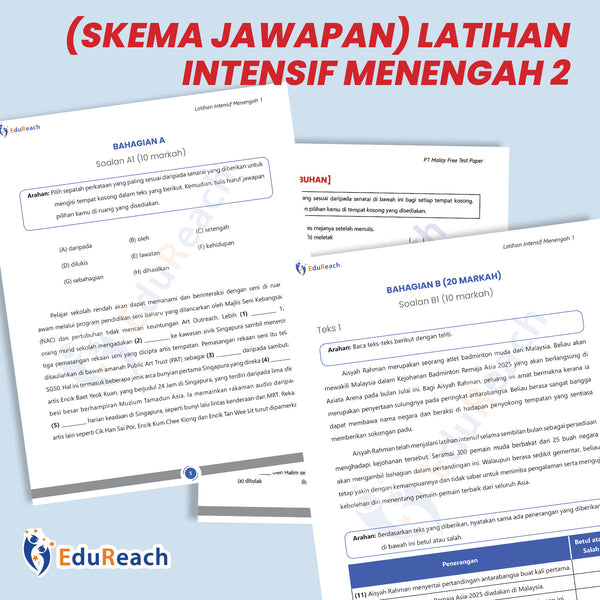
(Skema Jawapan) Latihan Intensif Menengah 2
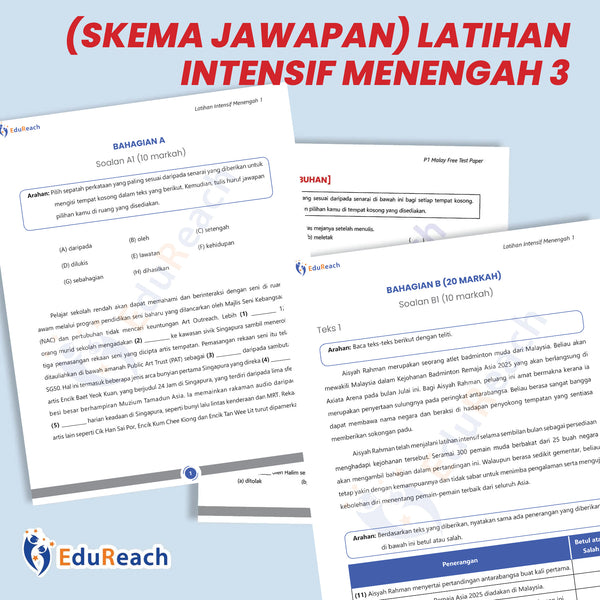
(Skema Jawapan) Latihan Intensif Menengah 3
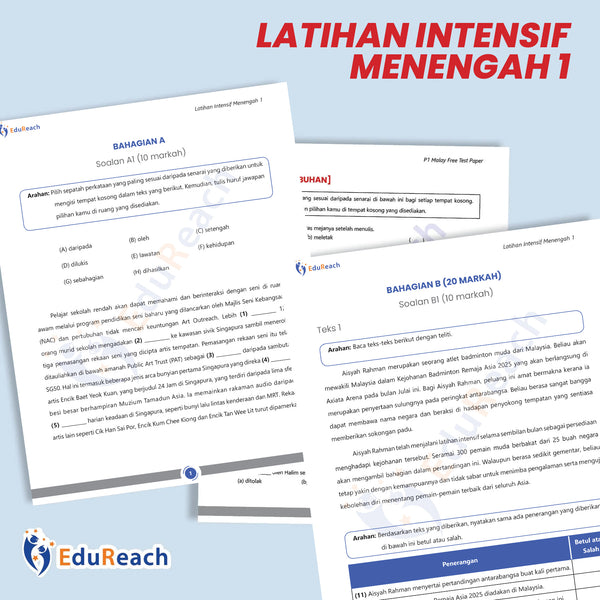
(Test Paper) Latihan Intensif Menengah 1
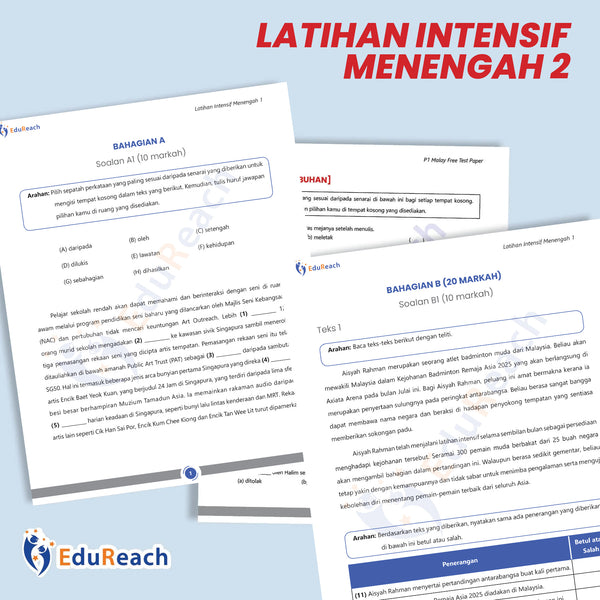
(Test Paper) Latihan Intensif Menengah 2
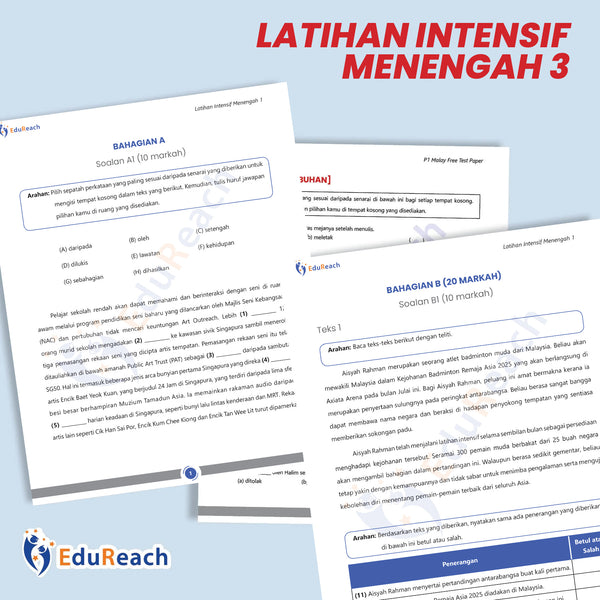
(Test Paper) Latihan Intensif Menengah 3
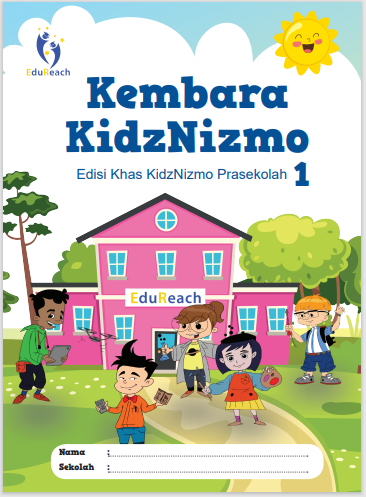
Kembara KidzNizmo (Edisi Khas KidzNizmo) Prasekolah 1