Malay Assessment Books Singapore 2026 | PSLE Guide P3-P6


🎓 Ready to Excel in Your Studies?
Join thousands of students who have improved their grades with EduReach's proven teaching methods. Start your journey to academic success today!
Enroll Now via WhatsAppIntroduction: Why Malay Composition and Oral Skills Matter More Than Ever in 2026
Singapore's education system continues to evolve, and for Malay language learners in 2026, the challenges are both significant and addressable. The PSLE Malay examination remains a critical determinant of academic trajectory, yet a substantial portion of Primary 6 students still struggle with composition writing and oral exams—two components that together account for 65% of total marks.
The performance gap persists. While students in other Mother Tongue languages maintain high pass rates, Malay language learners face unique challenges stemming primarily from limited home language exposure. Most students practice using materials that emphasize quantity over quality, or worse, rely on outdated workbooks that don't reflect the current MOE syllabus standards.
This comprehensive guide reveals how top-performing students leverage quality assessment books, structured practice frameworks, and strategic learning approaches to transform their Malay proficiency. Whether your child is in Primary 3 building foundational skills or preparing for PSLE in Primary 6, this guide provides actionable strategies backed by educational research and proven results.
Part 1: Understanding the Malay Language Curriculum in Singapore (2025-2026)
The Current MOE Syllabus: What Students Must Master
The Ministry of Education continuously updates the Malay Language curriculum to reflect contemporary communication needs and workplace readiness. The 2025-2026 approved syllabus emphasizes five critical assessment components:
1. Composition Writing (Penulisan Karangan) – 40% of PSLE marks
2. Oral Communication (Lisan) – 25% of PSLE marks
3. Reading Comprehension (Pemahaman Bacaan) – 20% of PSLE marks
4. Listening Skills (Mendengar) – 10% of PSLE marks
5. Grammar & Vocabulary (Tatabahasa & Perbendaharaan Kata) – Integrated throughout all components
Unlike English or Mathematics where answers are objective, Malay composition assessment is entirely subjective and nuanced. Examiners evaluate two primary dimensions:
Content Assessment (20 marks total):
-
Relevance to prompt and thematic consistency
-
Creativity and originality of narrative
-
Story structure and plot development
-
Character portrayal and dialogue authenticity
Language Assessment (20 marks total):
-
Vocabulary sophistication and variety
-
Grammar accuracy (tenses, particles, affixes)
-
Sentence construction complexity
-
Proper use of idioms and proverbs (peribahasa)
-
Clarity of expression and logical organization
This fundamental difference means rote memorization doesn't work. Students must practice authentic composition writing with guided feedback. Quality latihan efektif bahasa melayu bundles provide exactly this through systematic exposure to model compositions and detailed marking rubrics.
The Linguistic Reality: Why Home Exposure Matters
Recent educational research on Singapore's Malay language learners reveals a significant challenge:
-
Only 3% of students speak exclusively Malay at home
-
57% speak predominantly English in household conversations
-
34% are English-Malay bilinguals with variable proficiency
-
6% speak other languages (Tamil, Chinese dialects) as primary home language
This linguistic environment creates a vocabulary and fluency gap that standard school lessons alone cannot adequately bridge. Most students lack the rich, immersive exposure to colloquial Malay that builds natural language intuition and authentic expression.
Professional educators emphasize that quality Malay assessment books become essential supplementary tools—providing consistent, structured practice that compensates for limited home language exposure. Quality workbooks expose students to sophisticated vocabulary, natural sentence structures, and culturally appropriate expressions that rarely appear in casual conversation.
Part 2: Primary School Malay Composition – The Foundation Years (P3-P4)
Why Primary 3 & 4 Represent Critical Development Windows
Educational psychology research consistently demonstrates that Primary 3 and 4 are when students develop foundational writing habits and cognitive frameworks that persist throughout their academic journey. Early intervention during these formative years produces compounding advantages that become increasingly evident by Primary 6.
The Primary 3-4 Composition Assessment Format:
-
Minimum word requirement: 120-150 words
-
Target length for strong performance: 200-250 words
-
Time allocation: 30-35 minutes
-
Format: Picture-based prompts with multiple visual options
-
Assessment focus: Basic narrative structure, descriptive language, character introduction
Students who struggle at this foundational stage typically exhibit predictable patterns:
-
Limited descriptive vocabulary – Repetitive word choices ("nice," "good," "happy") without nuanced alternatives
-
Inability to structure coherent narratives – Random event sequences without logical progression
-
Weak sentence construction – Simple subject-verb-object patterns without complexity
-
Difficulty identifying story elements – Cannot distinguish setting from character development or climax from resolution
Essential Composition Skills for Primary 3-4 Success
Skill 1: Setting Development (Pembinaan Latar)
Strong compositions begin with immersive setting descriptions that ground readers in specific contexts. Quality assessment books systematically teach students to incorporate three essential elements:
Tempat (Place/Location):
Detailed physical descriptions using specific nouns and descriptive adjectives
Masa (Time/Temporal Setting):
Specific time markers that create atmosphere and context
Cuaca dan Suasana (Weather and Atmosphere):
Environmental details that enhance mood and support narrative tone
Example from Primary 3 Malay workbooks: "Hari itu adalah pagi yang cerah di perpustakaan sekolah. Cahaya matahari memasuki ruang perpustakaan melalui jendela besar, menerangi deretan buku yang tersusun rapi. Udara terasa sejuk dan menenangkan, dipenuhi aroma kertas lama yang khas."
Skill 2: Character Introduction and Development
MOE examiners reward compositions that introduce characters naturally and demonstrate emotional states through actions and dialogue rather than simple statements.
Skill 3: Chronological Narrative Structure
Despite contemporary creative writing trends that experiment with non-linear narratives, MOE examiners consistently reward students who follow proper chronological storytelling.
Primary 3-4 Assessment Book Selection: Essential Features
When evaluating assessment materials for lower primary students, parents and educators should verify these non-negotiable features:
✓ Current MOE syllabus alignment – Confirmed 2024-2026 curriculum standards
✓ Comprehensive sample compositions – Minimum 25-30 complete examples across diverse topics
✓ Guided practice with detailed explanations – Not just answers, but reasoning behind effective techniques
✓ Topic variety and thematic coverage – All common PSLE themes represented
✓ Integrated proverbs and idioms – Context-appropriate usage examples
✓ Oral component preparation – Speaking practice aligned with written skills development
The Primary 3 composition bundle exemplifies this comprehensive approach by including complete panduan lisan (oral guides), 30+ contextual proverbs, detailed marking rubrics, and progressive practice exercises.
Part 3: Upper Primary Composition Mastery (P5-P6 & PSLE Preparation)
The Difficulty Transition from P4 to P5: Understanding the Gap
Primary 5 represents a significant pedagogical inflection point. The composition expectations escalate substantially:
Complexity Increases:
-
Picture prompts become more ambiguous and interpretively open
-
Topics require deeper emotional intelligence and moral reasoning
-
Vocabulary expectations shift from basic to sophisticated
-
Word count requirements increase (minimum 150 words, recommended 250-300)
-
Time management becomes critical
Many commercially available assessment books fail to bridge this critical transition effectively. They either maintain Primary 4 simplicity or jump immediately to full PSLE complexity.
Quality transition materials like Koleksi Karangan Darjah 5 provide systematic coverage through:
Scaffolded Complexity:
-
20 topic-based compositions (thematic practice)
-
20 picture-based compositions (visual interpretation)
-
10 advanced PSLE-level examples (stretch challenges)
Strategic Learning Tools:
-
Mind map templates (peta minda) for organized pre-writing
-
Detailed marking rubrics showing exact point allocation
-
Annotated examples highlighting specific techniques
-
Progressive difficulty levels within each section
The PSLE Malay Composition Format (2026 Standards)
Paper 1 Composition Structure:
-
Total duration: 50 minutes for one complete composition
-
Task format: Choose one prompt from two provided options
-
Word requirement: Minimum 150 words (high-performing students target 250-300)
-
Total marks: 40 (20 content + 20 language)
-
Assessment approach: Holistic evaluation with specific criteria weighting
Content Marks Breakdown (20 total):
Relevance and Thematic Consistency (8 marks):
-
Does the composition directly address the prompt?
-
Is the story coherent and focused?
-
Are all narrative elements relevant to the central theme?
Story Development and Creativity (8 marks):
-
Is the narrative engaging and original?
-
Does the plot progress logically?
-
Are there interesting details and unexpected elements?
Character Portrayal and Dialogue (4 marks):
-
Are characters believable and well-developed?
-
Does dialogue sound natural and advance the story?
Language Marks Breakdown (20 total):
Vocabulary and Word Choice (8 marks):
-
Sophisticated, varied, and precise word selection
-
Appropriate register for context
Grammar and Sentence Structure (8 marks):
-
Correct verb tenses and agreement
-
Proper use of particles and affixes
-
Varied sentence structures
Proverbs and Idiomatic Expressions (2 marks):
-
Appropriate and natural use of peribahasa
-
Cultural appropriateness
Clarity and Organization (2 marks):
-
Logical paragraph transitions
-
Clear chronological flow
Students who consistently score 32+ marks (80%) demonstrate mastery across all these specific criteria. Assessment books that explicitly teach these elements create measurable, sustainable improvement.
Topic Mastery: The Strategic Advantage
PSLE composition topics follow predictable thematic patterns. While specific prompts vary annually, underlying themes recur consistently:
Students who practice compositions across all these thematic categories demonstrate superior performance. Quality assessment bundles for upper primary systematically cover all major themes, ensuring students encounter each topic type multiple times with progressive complexity.
Part 4: The Oral Component – Mastering the Often-Neglected 25%
Understanding Oral Exam Anxiety and Performance Barriers
Speech anxiety affects Malay language learners disproportionately compared to other subjects. Unlike English, where many Singaporean students develop conversational fluency through media, Malay oral skills require deliberate, structured practice.
Primary Contributing Factors:
1. Limited Authentic Language Exposure
Only 3% of students maintain Malay as the exclusive home language.
2. Unfamiliar Assessment Format
Many students never experience structured oral practice until Primary 6.
3. Real-Time Performance Pressure
Unlike written examinations, oral assessment demands immediate, fluent articulation.
4. Vocabulary Recall Under Stress
Even familiar words become inaccessible under pressure.
PSLE Malay Oral Assessment Format (2026)
Paper 3 (Oral) Complete Structure:
Duration: Approximately 10-15 minutes per student (individual assessment)
Component 1: Reading Aloud (10 marks, ~5 minutes)
-
Pronunciation accuracy and articulation clarity
-
Natural pacing and fluency
-
Expressive reading matching content meaning
Component 2: Stimulus-Based Conversation (40 marks, ~10 minutes)
-
Comprehension questions
-
Personal opinion questions
-
Hypothetical scenario questions
-
Elaboration prompts
Total Component Value: 50 marks = 25% of final PSLE Malay grade
The Assessment Book Solution: Integrated Oral Practice
Here's where most families miss a critical strategic advantage: single-skill assessment books focus exclusively on written composition, completely neglecting oral preparation. Integrated bundles that systematically combine written AND oral practice materials accelerate development dramatically.
For example, quality Primary 4 assessment bundles include:
Oral-Specific Components:
-
30+ contextual Malay proverbs with usage scenarios
-
Complete oral framework with progressive difficulty dialogues
-
Natural speech pattern examples and emphasis techniques
-
Common oral question types with model responses
-
Pronunciation guides for challenging words
-
Speaking confidence-building exercises
Research-Backed Results:
Students using integrated assessment bundles demonstrate 2-3 month acceleration compared to peers using written-composition-only materials. This advantage compounds over 3-4 years of primary school.
Part 5: Assessment Book Selection – Critical Features That Determine Effectiveness
Non-Negotiable Quality Indicators
When evaluating Malay assessment books in 2026, parents and educators must verify these essential technical features:
1. Current MOE Curriculum Alignment
-
Explicit statement of 2024-2026 MOE Malay Language Syllabus alignment
-
Official MOE approval indication (where applicable)
-
Publication or revision date of 2024 or later
-
Clear indication of PSLE format conformity
2. Comprehensive Topic and Format Coverage
✓ Sample compositions organized by thematic categories
✓ Picture-based composition examples (matching exam format)
✓ Substantial proverb and idiom lists (30-50+ per level)
✓ Integrated grammar and vocabulary sections
✓ Oral practice materials and conversation frameworks
✓ Mind mapping and pre-writing organizational tools
3. Detailed Model Solutions with Pedagogical Explanations
Quality materials provide:
-
Complete annotated model compositions (not just topic outlines)
-
Explicit explanations of why specific techniques work
-
Highlighting of examiner-valued elements
-
Detailed marking rubrics showing exact point allocation criteria
-
Common mistakes analysis with correction strategies
4. Scaffolded Progressive Difficulty
Effective assessment books systematically increase complexity:
Level 1 Foundation (P3-P4 early):
-
Simpler, concrete topics with familiar contexts
-
Shorter word count requirements (120-150 words)
-
Extensive scaffolding
Level 2 Development (P4 late-P5):
-
Medium complexity topics requiring some abstraction
-
Expanded vocabulary expectations
-
Moderate scaffolding
Level 3 Mastery (P5 late-P6):
-
PSLE-level difficulty with abstract or ambiguous prompts
-
Advanced thematic exploration
-
Minimal scaffolding
Quality Primary 5-6 assessment collections exemplify this progressive structure.
5. Integrated Oral Assessment Preparation
This feature is non-negotiable for 2026 success:
Essential oral components:
-
Oral question types aligned with current PSLE format
-
Progressive conversation practice (simple to complex)
-
Natural pronunciation and expression guidance
-
Vocabulary recall strategies under time pressure
-
Response structure frameworks
-
Digital audio/video supplements (via QR codes where available)
Part 6: Creating a Structured Practice Schedule – From Assessment to Mastery
The Research-Backed Practice Framework
Educational psychology research confirms that assessment books produce measurable results only when integrated into structured, consistent practice routines.
The Optimal Weekly Schedule (P5-P6 Intensive Preparation):
Day 1-2 (30 minutes each day): Active Reading and Technique Analysis
-
Read 2-3 model compositions from assessment book
-
Identify and annotate specific techniques
-
Note vocabulary patterns and sophisticated word choices
Day 3 (40 minutes): Guided Composition Practice
-
Attempt one complete composition using planning template
-
Focus on applying 2-3 specific techniques from studied examples
-
Target appropriate word count (200-250 words)
Day 4 (30 minutes): Self-Assessment and Improvement Analysis
-
Compare own composition to provided model answer
-
Use marking rubric to self-evaluate
-
Identify specific gaps
Day 5 (20 minutes): Oral Reading Practice
-
Read aloud 1-2 sample compositions focusing on fluency
-
Practice natural pronunciation and expression
-
Record and listen to identify areas for improvement
Day 6 (30 minutes): Stimulus-Based Conversation Practice
-
Use picture prompts from assessment book
-
Practice structured oral responses
-
Focus on natural, confident delivery
Day 7: Review and Planning
-
Review week's progress and achievements
-
Identify persistent weak areas
-
Plan specific focus for upcoming week
Total Weekly Investment: 3 hours
Expected Results: Measurable improvement within 8-12 weeks
Students following this progression with quality integrated assessment books typically demonstrate 15-25% score improvement within 3 months.
Part 7: The Competitive Advantage – What Top Scorers Do Differently
Benchmark Insights: Analyzing High-Performance Student Practices
Educational research on students who consistently achieve 80%+ scores in PSLE Malay reveals predictable, replicable behavioral patterns:
Pattern 1: Systematic, Exhaustive Topic Mastery
Rather than random practice, top performers work through assessment books methodically:
-
Complete compositions on every provided topic
-
Revisit challenging topics multiple times
-
Maintain topic-specific vocabulary lists
-
Practice topic variation across different contexts
Pattern 2: Natural, Contextual Proverb Integration
Phrases like "Sedikit demi sedikit, lama-lama jadi bukit" appear naturally in high-scoring compositions—integrated seamlessly into narrative flow.
Pattern 3: Consistent Weekly Oral Reading Practice
Top scorers practice oral reading every single week throughout the school year:
-
Read model compositions aloud regularly
-
Focus on natural intonation and expression
-
Record and self-evaluate pronunciation
Pattern 4: Deliberate Speed Development
Successful students systematically increase writing speed:
-
Early practice: 150 words in 50 minutes
-
Intermediate practice: 200-250 words in 45 minutes
-
Advanced practice: 300+ words in 40 minutes
Pattern 5: Vocabulary Expansion Beyond Assessment Books
While assessment books provide essential structure and foundation, top scorers supplement with:
-
Regular reading (Malay storybooks, novels, news articles)
-
Media consumption (Malay movies, TV shows)
-
Active conversation with peers or tutors
-
Vocabulary journaling
The Compound Advantage: Why Starting Early Matters
Students who begin systematic assessment book practice in Primary 3 (ages 8-9) achieve dramatically different PSLE outcomes compared to those starting intensive preparation only in Primary 5.
Comparative Analysis: P3 Start vs. P5 Start
Primary 3 Early Start:
-
3 years of systematic practice = 468 total practice hours by PSLE
-
Compound skill development with progressive complexity
-
Deep familiarity with all topic types
Primary 5 Late Start:
-
1.5 years of intensive practice = 234 total practice hours by PSLE
-
Rushed skill development attempting to cover 3 years of material
-
Gaps in foundational techniques
Performance Differential:
The 234-hour practice difference compounds into substantial score advantages—typically 15-25 percentage points by PSLE. Students with early starts demonstrate greater confidence, lower exam anxiety, and more sophisticated vocabulary mastery.
Parents who invest in quality Primary 3 Malay assessment bundles create years of upstream advantage.
Part 8: Platform Selection – Where to Purchase and Why Quality Matters
Singapore's Educational Materials Ecosystem (2026)
Singapore maintains a robust, competitive market for educational assessment materials through multiple channels:
Major Retail Chains:
-
Popular Book Company – Established reputation, extensive selection, knowledgeable staff
-
MPH Online – Convenient e-commerce platform, competitive pricing, regular promotions
-
Times Bookstore – Centrally located outlets, curated educational sections
Online Marketplaces:
-
Shopee Singapore – Extensive seller network, user reviews, frequent discounts
-
Lazada Singapore – Fast delivery, customer protection, seasonal sales
-
Qoo10 – Direct publisher listings, bundle deals
Specialized Educational Publishers:
-
EduReach Singapore – Malay language specialists, MOE-aligned materials
-
Success Publications – Long-standing publisher of Singapore assessment books
-
Cambridge University Press – International reputation, structured progression
-
Pelangi Books – Malaysia-Singapore cross-border distribution
Bundle vs. Single Book: Strategic ROI Analysis
Single Workbook Economics:
-
Koleksi Karangan composition book: $9-14 SGD
-
Separate oral practice materials: $8-12 SGD
-
Grammar workbook: $10-15 SGD
-
Total for piecemeal approach: $27-41 SGD
Comprehensive Bundle Economics:
-
Integrated Primary 3 bundle (composition + oral + proverbs + rubrics): $22.90 SGD
-
Integrated Primary 4 bundle: $35-40 SGD
-
Integrated Primary 5 bundle: $18-24 SGD
-
Integrated Primary 6 PSLE bundle: $24-32 SGD
Bundle Advantages:
-
Cost efficiency: 20-40% savings compared to piecemeal purchases
-
Pedagogical coherence: Integrated approach prevents learning fragmentation
-
Convenience: Single comprehensive resource rather than juggling multiple workbooks
-
Progressive alignment: Each level builds systematically on previous skills
-
Superior rubrics and explanations: Premium materials invest more in pedagogical depth
Part 9: Success Stories – Real Results from Systematic Assessment Book Practice
Case Study 1: Sarah, Primary 4 – From Struggling to Confident
Initial Assessment (August, Primary 4):
-
Weekly composition scores: Average 12/20 content marks (60%)
-
Oral participation: Minimal, pronounced speech anxiety
-
Vocabulary: Limited range, repetitive basic words
Intervention Strategy:
-
Purchased comprehensive Primary 4 assessment bundle ($35-40 SGD)
-
Implemented structured 3-hour weekly practice schedule
-
Focused intensively on story development techniques from model compositions
-
Regular oral practice using provided dialogue frameworks
Results (December, 4 months later):
-
Weekly composition scores: Average 16-17/20 content marks (80-85%)
-
Oral response length: Increased from average 20 seconds to 60+ seconds
-
Vocabulary: Natural integration of sophisticated descriptive words
-
Confidence: Active classroom participation, significantly reduced exam anxiety
-
Measurable improvement: +4-5 content marks = approximately 20-25% score increase
Critical Success Factors:
-
Consistent weekly practice without gaps
-
Integrated approach (composition + oral simultaneous development)
-
Structured feedback using rubrics
-
Progressive complexity aligned with current skill level
Case Study 2: David, Primary 6 – PSLE Preparation Acceleration
Initial Assessment (April, Primary 6):
-
Previous Primary 5 composition scores: Average 14/20 marks (70%)
-
No systematic PSLE preparation undertaken
-
Competing with peers who began intensive tuition in Primary 5
-
Family sought improvement without expensive weekly tuition commitment
Intervention Strategy:
-
Purchased Primary 6 Ultimate Bundle ($24-32 SGD - PSLE preparation materials)
-
Implemented intensive 5-hour weekly study plan
-
Part-time tutor engagement (fortnightly, significantly less expensive than weekly tuition)
-
Strategic combination: Self-directed assessment book practice + periodic professional feedback
Results (September, 7 months later):
-
Preliminary exam composition: 32/40 marks (80%)
-
Preliminary exam oral: 42/50 marks (84%)
-
Overall Malay preliminary result: Strong AL2 (Above Average)
-
Improvement from P5 baseline: +18 marks ≈ 32% increase
-
Cost savings: Approximately $2,000-3,000 compared to weekly tuition over same period
Critical Success Factors:
-
Intensive, consistent practice schedule
-
Quality assessment materials providing comprehensive PSLE coverage
-
Strategic tutor engagement (guidance rather than dependency)
-
Student ownership and self-directed learning
Part 10: Moving Forward – Selecting Your Child's Assessment Book Today
Decision Framework: Choosing the Right Bundle for Your Child's Level
For Primary 3 Students: Building Strong Foundations
Get Latihan Efektif Darjah 3 Bundle - SGD $22.90
Latihan Efektif Darjah 3 Bundle - $22.90 SGD
30+ Sample Compositions | Oral Guides | Proverbs | Marking Rubrics
Strategic rationale:
-
Introduces proper composition structure at foundational developmental stage
-
Includes integrated oral guide (critical for early confidence building)
-
30+ complete sample compositions preventing "what should I write?" confusion
-
Comprehensive proverb list creating early vocabulary foundation
-
Age-appropriate complexity matching P3 cognitive development
-
Comprehensive coverage for entire school year
Optimal for:
-
Students beginning systematic Malay practice
-
Families taking proactive, long-term approach
-
Building sustainable study habits early
-
Establishing strong foundational techniques
For Primary 4 Students: Transitional Development
Get Latihan Efektif Darjah 4 Bundle - SGD $35-40
Latihan Efektif Darjah 4 Bundle - $35-40 SGD
Oral Guides | Advanced Composition Models | Complete Framework
Strategic rationale:
-
Latihan Efektif component covers oral development and foundational writing
-
Koleksi Karangan component provides advanced composition models
-
Combined approach balances foundation reinforcement and mastery building
-
Specifically prepares students for Primary 5 difficulty transition
-
Bridges gap between basic P3 skills and advanced P5-P6 expectations
-
Comprehensive integrated coverage for entire school year
Optimal for:
-
Students solidifying foundational skills
-
Preparing for upper primary complexity
-
Families seeking comprehensive, cost-effective solutions
-
Building consistency before PSLE preparation intensifies
For Primary 5 Students: Advanced Skill Development
Get Koleksi Karangan Darjah 5 - SGD $18-24
Koleksi Karangan Serta Panduan Mengarang Darjah 5 - $18-24 SGD
50 Sample Compositions | Mind Maps | Rubrics | Oral Materials
Strategic rationale:
-
Advanced composition guide specifically targeting P4-P6 difficulty transition
-
50 comprehensive sample compositions:
-
20 topic-based compositions (thematic mastery)
-
20 picture-based compositions (visual interpretation)
-
10 advanced PSLE-preview examples
-
-
Mind map templates (peta minda) accelerating planning and organization
-
Explicit detailed marking rubrics revealing exact MOE examiner expectations
-
Integrated oral preparation materials
-
Strategic bridge between lower and upper primary composition skills
Optimal for:
-
Students experiencing P5 difficulty jump
-
Building advanced techniques and sophistication
-
Families preparing seriously for upcoming PSLE
-
Students needing comprehensive topic coverage
For Primary 6 Students: PSLE Preparation Intensive
Get Primary 6 Ultimate Bundle - SGD $24-32
Primary 6 Ultimate Bundle - $24-32 SGD
40 PSLE-Format Essays | Oral Simulations | Time Management | Complete Preparation
Strategic rationale:
-
Exam-aligned format precisely matching 2026 PSLE standards
-
Complete mock examination preparation (written + oral components)
-
40 sample compositions covering all predicted PSLE themes
-
Full oral examination simulation materials
-
Time management strategies and exam technique optimization
-
Bonus: Comprehensive proverb consolidation and revision materials
-
Most comprehensive preparation for final examination push
Optimal for:
-
Students in final PSLE preparation year
-
Intensive exam-focused practice
-
Families seeking comprehensive, structured preparation
-
Students targeting AL1-AL2 performance levels
Investment Strategy: Phased Annual Approach vs. Multi-Level Bundle
Strategy A: Phased Annual Investment (Recommended for Most Families)
Year-by-year progression:
-
Primary 3: Latihan Efektif Darjah 3 - SGD $22.90
-
Primary 4: Latihan Efektif Darjah 4 - SGD $35-40
-
Primary 5: Koleksi Karangan Darjah 5 - SGD $18-24
-
Primary 6: Primary 6 Ultimate Bundle - SGD $24-32
Total 4-year investment: ~$100-120 SGD
Per-child monthly cost: ~$2-2.50 SGD
Per-child weekly cost: ~$0.50-0.60 SGD
Comparative cost analysis:
-
Group tuition: $50-80 per month = $2,400-3,840 over 4 years
-
Private tutoring: $100-150 per hour, 2 hours weekly = $8,000-12,000 over 4 years
-
Quality assessment books + parent involvement: $100-120 over 4 years
Value proposition: 95-99% cost savings with comparable (often superior) results when implemented consistently.
Conclusion: Making the Decision That Changes Your Child's Academic Trajectory
The research and case studies presented throughout this guide reveal a consistent, evidence-backed conclusion: Assessment book quality, systematic practice methodology, and early consistent implementation determine PSLE Malay performance more significantly than innate linguistic ability or socioeconomic factors.
Nearly 70% of students don't achieve optimal performance—not because they lack intelligence or potential, but because they lack proper resources, structured practice frameworks, and consistent implementation strategies.
Your Three-Step Action Plan
Step 1: Immediate Assessment and Selection (This Week)
Identify your child's current primary level:
-
Review the recommended assessment bundle for their level
-
Verify MOE curriculum alignment (2024-2026 standards)
-
Check publication recency (2023 or later)
-
Read authentic user reviews from parent purchasers
-
Confirm integrated oral components included
Step 2: Strategic Purchase and Resource Preparation (This Month)
Acquire recommended bundle through preferred platform:
-
Direct from publisher: EduReach Singapore – latest editions, bundle discounts
-
Online marketplaces: Shopee.sg, Lazada – frequent promotions, user reviews
-
Major retailers: Popular Book Company, MPH – physical verification before purchase
Budget realistic weekly practice time:
-
Primary 3-4: 2-3 hours weekly
-
Primary 5: 3-4 hours weekly
-
Primary 6: 4-5 hours weekly (PSLE preparation intensive)
Step 3: Consistent Implementation and Progress Tracking (Starting Next Week)
Implement structured practice schedule and track weekly progress systematically.
The Compound Advantage Starts Today
Students achieving AL1 (Excellent) in PSLE Malay aren't necessarily the most naturally gifted—they're students whose families invested in systematic preparation using quality assessment materials, implemented consistent practice schedules, and maintained long-term commitment.
Your child's Malay language proficiency isn't predetermined. It's determined by resources quality, practice consistency, and strategic implementation.
The 234-hour compound advantage separating Primary 3 starters from Primary 5 starters begins with a single decision made today.
Try Before You Commit!
Book a FREE trial class and experience our teaching excellence firsthand.
Need Personalized Guidance?
Speak with our education consultants to find the perfect program for your child.
Join the EduReach Family Today!
Be part of Singapore's most trusted tuition center with 4 convenient locations and personalized learning programs designed for your success.
💡 Free trial class available • No obligation • Flexible schedules
📚 Essential Education Books & Resources
Enhance learning with our curated selection of English, Math, and Science materials.
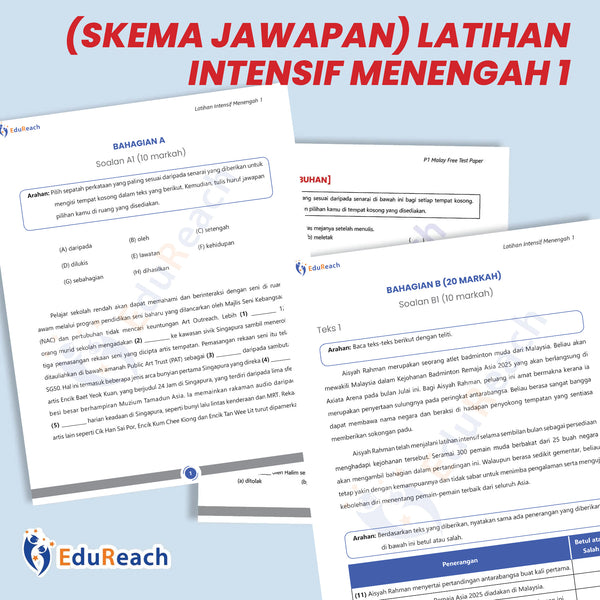
(Skema Jawapan) Latihan Intensif Menengah 1
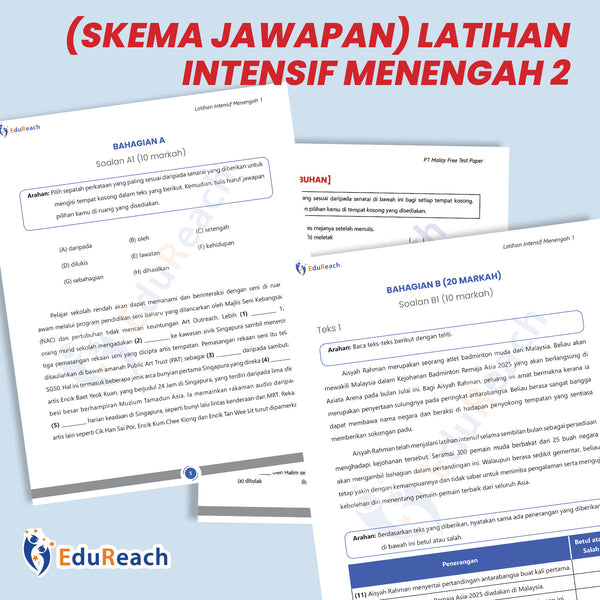
(Skema Jawapan) Latihan Intensif Menengah 2
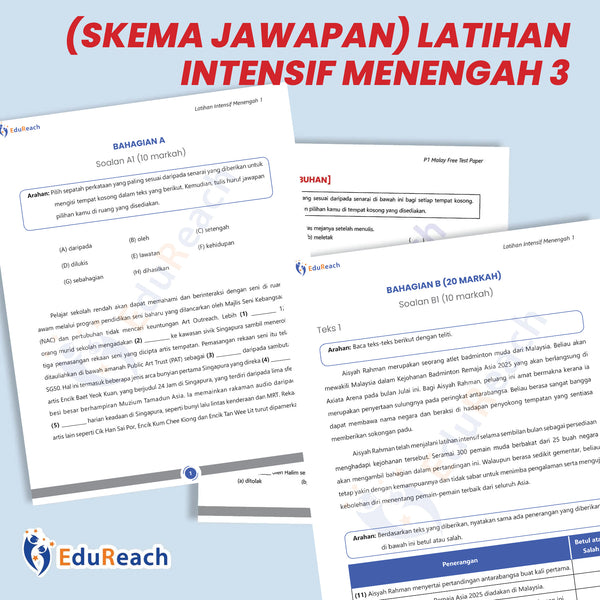
(Skema Jawapan) Latihan Intensif Menengah 3
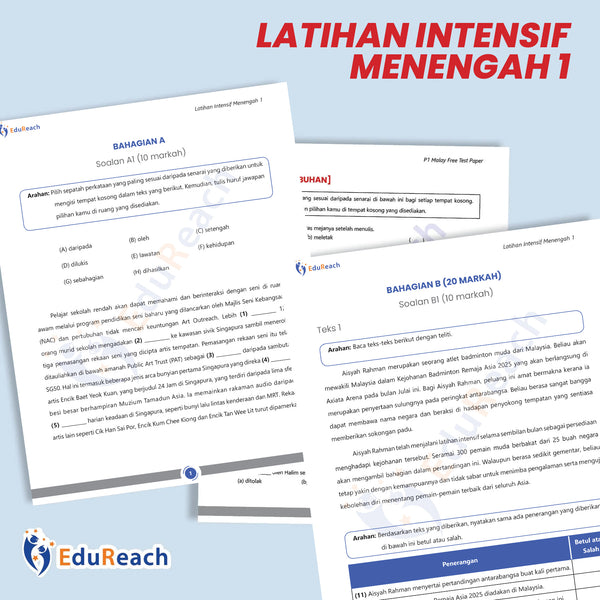
(Test Paper) Latihan Intensif Menengah 1
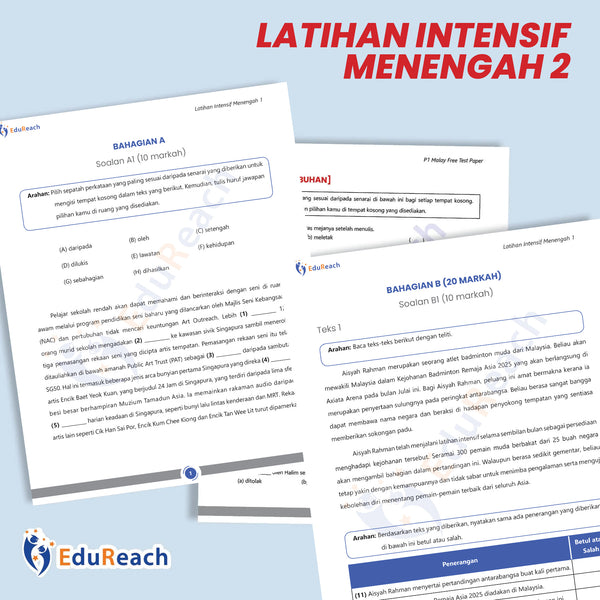
(Test Paper) Latihan Intensif Menengah 2
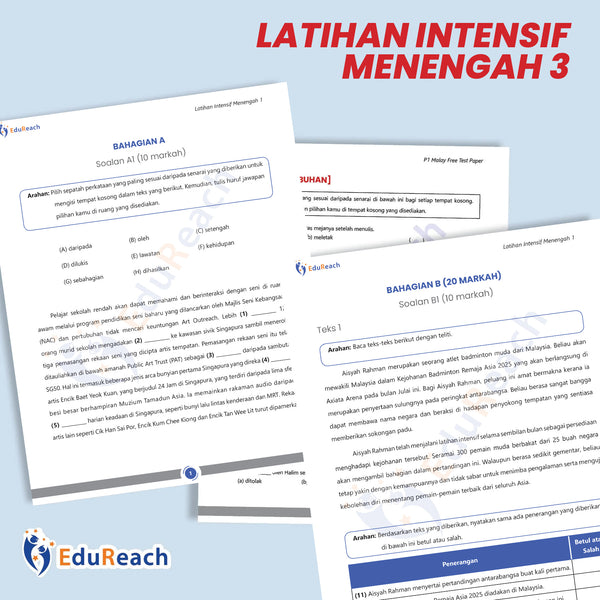
(Test Paper) Latihan Intensif Menengah 3
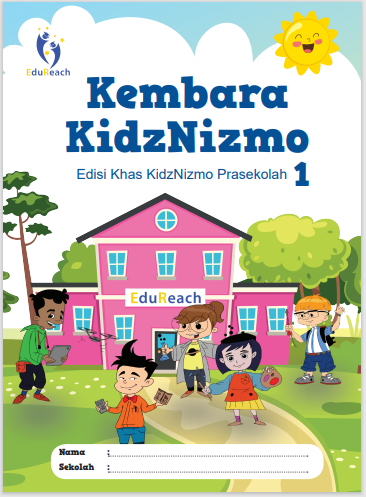
Kembara KidzNizmo (Edisi Khas KidzNizmo) Prasekolah 1