Latihan Intensif Menengah 3: Sec 3 O-Level Malay Guide 2026


🎓 Ready to Excel in Your Studies?
Join thousands of students who have improved their grades with EduReach's proven teaching methods. Start your journey to academic success today!
Enroll Now via WhatsAppSecondary 3 marks the turning point. Two years until O-Level. Suddenly that "I'll catch up later" approach to Malay doesn't work anymore. Preliminary exams arrive with their wake-up calls—passages you can't fully understand, compositions that never quite reach the word count, oral exams where words just won't come out smoothly.
If that sounds familiar, you're not alone. The jump from Secondary 2 to Secondary 3 Malay hits harder than most students expect. The comprehension passages get longer and more complex. The grammar expectations assume mastery, not just recognition. And the oral component? That requires actual fluency now, not just reading prepared scripts.
This guide walks you through everything about Latihan Intensif Bahasa Melayu Menengah 3—what's inside, who benefits most, and exactly how to use it for serious O-Level preparation.
Why Secondary 3 Malay Preparation Feels Different
Lower secondary Malay had breathing room. Teachers introduced concepts gradually. Tests covered one chapter at a time. Mistakes felt fixable because "there's still time."
Secondary 3 removes that safety net. Everything accelerates:
Comprehension passages now test inference and evaluation, not just literal understanding. Questions ask "why did the author...?" and "what can be inferred...?" instead of "what happened...?"
Grammar components assume you've mastered basics. Questions target advanced structures—complex sentences, sophisticated connectors, nuanced tenses. The easy marks from simple grammar disappeared.
Composition expectations demand mature expression and sophisticated vocabulary. That 250-word minimum feels longer when you need to demonstrate language range and complexity, not just meet word count.
Oral examinations require spontaneous discussion of abstract topics—technology's impact on society, environmental responsibility, cultural values. Gone are the simple picture descriptions of lower secondary.
Time pressure intensifies. With just 18-24 months until O-Level (or 12 months for students taking O-Level Malay in Sec 3), every term counts. Gaps don't fix themselves anymore.
Students who coasted through Secondary 1 and Secondary 2 often face reality checks during Sec 3 mid-year exams. The difficulty jump is real. The margin for casual effort vanishes.
This is exactly where systematic practice with O-Level-aligned materials becomes essential.
What's Inside Latihan Intensif Menengah 3
This isn't a collection of random exercises. It's a structured O-Level preparation system designed for Singapore's GCE examination format.
Component A1: Comprehension Practice (20 Worksheets)
Twenty comprehension passages structured to mirror O-Level difficulty and question formats. These passages cover the range you'll encounter in actual examinations:
Literary texts exploring themes, character development, and narrative techniques. Questions test your ability to analyze author's craft and interpret deeper meanings.
Expository articles on complex topics—technology, social issues, environmental concerns, cultural heritage. The vocabulary and concepts match what O-Level examiners use.
Persuasive pieces requiring evaluation of arguments, identification of persuasive techniques, and analysis of author's purpose and tone.
Mixed question types spanning literal comprehension through inference, evaluation, and summary—exactly the cognitive levels O-Level examinations assess.
Each passage includes 8-12 questions with clear mark allocations. You learn what 1-mark questions require (brief answers) versus 3-mark questions (detailed responses with supporting evidence).
The answer keys provide complete model responses showing exactly what examiners look for. Not just "what's the right answer" but "why is this answer complete and that one isn't."
Component A2: Language Use & Grammar (20 Worksheets)
Advanced grammar and language exercises covering O-Level curriculum requirements:
Complex sentence structures with multiple clauses and sophisticated connectors
Advanced verb forms including perfect progressive, conditional constructions, and subtle tense distinctions
Sophisticated vocabulary in context—learning words through meaningful passages, not isolated lists
Register appropriateness distinguishing formal written Malay from conversational usage
Error identification training you to spot common mistakes in your own writing
Transformation exercises developing flexibility with language structures
Each worksheet progresses from guided practice through independent application. Early exercises provide support—word banks, partial completion, clear models. Later exercises remove scaffolding, requiring you to apply concepts independently.
This progression builds automatic language use, not just rule memorization. The difference between students who freeze under examination pressure and those who write confidently comes down to this automaticity.
Integrated Oral Preparation (Panduan Lisan)
The oral component carries 25% of your O-Level Malay grade—too significant to leave to last-minute cramming. This workbook integrates oral preparation throughout:
Reading aloud passages with guidance on pronunciation, stress patterns, and natural intonation
Picture stimulus discussions teaching structured observation, inference, and opinion articulation
Conversational frameworks for discussing current affairs, social issues, values, and abstract concepts
Model responses at different proficiency levels showing what distinguishes excellent oral performance from average attempts
The oral guide addresses Secondary 3 realities. You're not just describing pictures anymore—you're analyzing situations, connecting to broader themes, expressing nuanced opinions. The frameworks teach this sophisticated discussion systematically.
Topics covered reflect recent O-Level examination trends: technology and relationships, environmental responsibility, education pressures, cultural preservation, youth aspirations, social media effects. For each topic, you get essential vocabulary, useful phrases, and multiple perspectives.
Pronunciation guidance targets sounds Singaporean students typically struggle with—specific Malay phonemes absent in English, stress patterns, natural rhythm and flow.
Complete Answer Keys with Detailed Explanations
Every exercise includes comprehensive answer keys. Not just correct answers—explanations showing why answers are correct, what examiners look for, and common errors to avoid.
For comprehension: Model answers demonstrate proper evidence citation, sufficient detail for mark allocation, and sophisticated expression earning full marks.
For grammar: Explanations clarify rules, show application in context, and address common Singapore student errors.
For oral: Sample responses illustrate vocabulary range, sentence complexity, idea development, and natural fluency that examiners reward with distinction-level marks.
These detailed explanations function like built-in tutoring, helping you understand not just what to do but why and how.
Who Should Use This Secondary 3 Malay Workbook
Express Stream Students Preparing for O-Level
This workbook's primary design target is Express stream G3 students. Every exercise aligns with MOE Secondary 3 Express syllabus and progresses toward O-Level examination standards.
If you're in Express stream taking O-Level Malay in Secondary 4, this workbook provides the systematic practice foundation you need throughout Secondary 3.
Students taking Higher Malay O-Level at the end of Secondary 3 benefit from the advanced content and tight practice timeline.
Students Currently Scoring B3-C6
If your school results consistently fall in B3-C6 range, this workbook addresses exactly what you need—structured practice building toward higher grades.
The detailed answer explanations help you understand not just correct answers but examiner expectations. This understanding often proves transformative—you stop repeating the same mistake types because you internalize what earns marks.
High Achievers Maintaining A1-A2 Performance
Already scoring well? This workbook serves as refinement practice ensuring consistent performance under examination pressure.
Use it to identify remaining weak areas, practice maintaining accuracy under time constraints, and expose yourself to the full range of question types and passage complexities O-Level presents.
Even excellent students discover gaps when practicing with properly calibrated difficulty.
Students Catching Up from Earlier Years
Struggled in Secondary 1-2? This workbook helps, especially when combined with quality instruction from teachers or professional Malay tuition.
The comprehensive answer explanations clarify concepts you may have missed previously. Starting from the first worksheets, which review foundational concepts, you can systematically fill gaps while building toward advanced skills.
However, students with severe foundational issues (consistently scoring below 40%) should combine workbook practice with professional teaching rather than attempting completely independent study.
Students Preparing for Preliminary Examinations
Mid-year Secondary 3 exams coming? Secondary 4 preliminary O-Level papers approaching? This workbook provides intensive revision covering all major topics and question types.
The 40 worksheets (20 comprehension + 20 language) offer sufficient practice volume to systematically address every component tested in school preliminary papers and national examinations.
Continuing from Secondary 2 Latihan Intensif
If you used Latihan Intensif Menengah 2, you already understand the format and methodology. Continue with Menengah 3 for seamless progression—familiar structure, increasing difficulty, consistent approach.
This continuity matters during time-pressured upper secondary years. You focus on mastering increasingly complex content rather than adapting to unfamiliar resource formats.
How to Use This Workbook Strategically
Simply owning a workbook guarantees nothing. Strategic implementation determines whether it translates to actual improvement.
Create Your Practice Schedule
Recommended frequency: 45-60 minute sessions, 4 times weekly
At this pace, complete 1-2 worksheets per session. You'll finish the entire workbook in 8-10 weeks, leaving ample Secondary 4 time for revision and Ten Year Series practice.
Best practice times: Mid-morning weekends or early evening weekdays before dinner—peak cognitive hours when you're alert and focused.
Consistency over intensity: Four 45-minute weekly sessions outperform one 3-hour marathon. Distributed practice enhances retention. Your brain consolidates learning during rest periods between sessions.
Avoid late-night practice when fatigue causes errors and poor retention. O-Level preparation is a marathon requiring sustainable routines, not sporadic bursts followed by burnout.
Start with Diagnostic Assessment
Before systematic practice, complete one A1 worksheet and one A2 worksheet under timed conditions. No answer key peeking while working.
Score honestly. This diagnostic reveals your current baseline and specific weak areas.
If scores below 60%: Prioritize grammar (Component A2) as weak foundations undermine all other components. Students with grammar weakness struggle expressing understanding even when they comprehend passages.
If comprehension lags significantly: Dedicate extra time to Component A1, practicing active reading strategies the workbook teaches.
Create a simple weakness tracking sheet listing areas needing improvement. After each practice session, note which question types caused errors. Patterns emerge over time—inference questions, specific grammar structures, vocabulary limitations.
Use these insights to prioritize practice on your actual weak areas rather than working mindlessly through sequential worksheets.
Practice Active Learning
At Secondary 3 level, passive exercise completion produces minimal improvement. Implement sophisticated learning strategies:
For comprehension passages:
-
Read once for general understanding
-
Re-read strategically when answering questions
-
Physically underline key evidence phrases before formulating answers
-
Check answers against your underlining—did you miss crucial evidence?
For language exercises:
-
Say the grammatical rule aloud before answering
-
Verbalization strengthens memory and understanding
-
Write brief explanations for why wrong answers are incorrect
After marking:
-
Don't just note correct answers
-
Analyze WHY you made errors
-
Were they conceptual misunderstandings? Careless mistakes? Exam technique issues?
-
Different error types require different remedies
Maintain an error log:
-
Record recurring mistake patterns
-
Write brief explanations
-
Revisit these areas weekly until patterns break
Build Examination Speed
Complete exercises under time constraints mirroring actual examinations:
-
Comprehension questions: 3-4 minutes each
-
Grammar questions: 1.5-2 minutes each
Initially you may need more time. That's expected. Gradually tighten time limits building the speed O-Level demands.
O-Level papers contain more questions than most students can comfortably complete. Speed without accuracy means nothing, but accuracy without speed fails examinations. Deliberate speed practice prevents this trap.
Integrate Oral Practice Systematically
The oral component requires deliberate speaking practice. It feels awkward but proves essential.
Effective oral practice strategies:
Record yourself: Use your phone responding to prompts. Listen critically to pronunciation, fluency, and response quality. Most students are shocked hearing themselves the first time—awareness drives improvement.
Time strictly: Picture discussions typically 2-3 minutes, conversational components 3-5 minutes. Examiners maintain tight schedules and will interrupt if you exceed time limits.
Practice with peers: Reciprocal practice with classmates simulates examination conditions while providing mutual support and feedback.
Seek expert feedback: Malay-speaking family members, teachers, or qualified tuition instructors identify specific pronunciation and fluency issues you can't self-diagnose.
Many students neglect oral practice because they're embarrassed or lack partners. The oral component constitutes 25% of O-Level marks—too significant to neglect.
Coordinate with School Learning
Use this workbook strategically reinforcing school curriculum, not as disconnected separate practice.
After each school chapter test: Identify topics you struggled with. Complete corresponding workbook sections for targeted remediation. This responsive approach addresses weaknesses immediately before they accumulate.
Before preliminary examinations: Systematically work through all 40 worksheets as comprehensive revision, focusing especially on previously identified weak areas.
Coordinate with your teacher: Share your practice plans. Ask for specific topic recommendations aligning with upcoming school assessments. Most teachers appreciate student initiative and provide targeted guidance.
Your Secondary 3-4 O-Level Preparation Timeline
Strategic planning maximizes the limited time remaining until O-Level examinations.
Secondary 3 Term 1-2 (January-June): Foundation Building
Complete Latihan Intensif Menengah 3 systematically during these months. Work through the entire workbook once, focusing on understanding concepts and building skills rather than rushing through.
This phase emphasizes learning over speed. Take time with answer explanations. Redo exercises you scored poorly on until concepts solidify.
Goal: Complete all 40 worksheets once with 70%+ accuracy by June.
Secondary 3 Term 3-4 (July-December): Targeted Improvement
Revisit weak areas identified during initial practice. Redo worksheets where you scored below 70%, attempting score improvements.
Begin incorporating past-year school preliminary papers for examination format familiarization.
Practice complete essay writing under timed conditions weekly.
Goal: Improve weak area scores to 75%+. Develop examination timing instincts.
Secondary 4 Term 1 (January-March): Intensive Revision
Shift to O-Level-specific materials. Complete Ten Year Series O-Level papers under strict examination timing.
Identify recurring question types across years and drill these specifically.
Begin weekly oral practice sessions focusing on recent examination topics.
Goal: Complete 5-6 full O-Level papers under timed conditions.
Secondary 4 Term 2-3 (April-September): Final Preparation
Weekly timed practice papers maintaining sharpness.
Intensive oral drilling with teachers, tutors, or capable family members.
Targeted weak area remediation based on practice paper performance.
The final week before O-Level: Consolidation, not learning new content. Light practice maintaining sharpness without exhaustion.
Goal: Enter O-Level examination confident, prepared, and mentally fresh.
Beyond Workbooks: Holistic Language Development
Systematic workbook practice forms your foundation. Authentic language exposure accelerates proficiency and builds cultural knowledge examinations increasingly assess.
Read Berita Harian Regularly
Singapore's main Malay newspaper provides current affairs knowledge enriching oral examination responses. Opinion pieces model the sophisticated argumentation your compositions need.
Practical approach: 2-3 articles weekly, focusing on topics relevant to students—education, technology, youth issues, environment.
Watch Malay Language Media
Suria channel news programs: Improve listening comprehension and vocabulary through authentic language use.
Malay dramas or variety shows: Build natural language intuition and cultural familiarity making idiomatic expressions feel natural rather than memorized.
YouTube channels in Malay: Find channels covering topics you're genuinely interested in. Entertainment that teaches is highly effective.
Practice Conversational Malay
Use Malay with family, friends, or community members when opportunities arise. Even brief conversations build fluency and confidence impossible through written practice alone.
Don't worry about mistakes in casual conversation—fluency develops through use, not perfection.
Maintain a Simple Malay Journal
Beyond workbook exercises, write brief weekly journal entries in Malay. Describe your week, express opinions on current issues, practice new vocabulary in context.
This regular expression builds comfort with writing that translates to examination confidence.
Complementary Resources for Complete O-Level Preparation
Latihan Intensif GCE O-Level provides past O-Level papers and examination-specific practice for Secondary 4.
Professional Malay tuition at EduReach offers expert teaching, personalized feedback, and structured oral practice complementing independent workbook study.
PSLE Malay resources provide additional context for understanding Singapore's Malay education progression.
Ten Year Series past papers familiarize you with actual examination format and difficulty after you've built skills through systematic workbook practice.
Common Questions About Secondary 3 Malay Preparation
When should I start using this workbook?
Beginning of Secondary 3 provides optimal timing—sufficient time for complete practice without rushing, early enough to address gaps before they compound.
Can I use this independently without tuition?
Self-motivated students with decent foundational skills can succeed using this workbook independently. The detailed answer explanations support self-directed learning.
However, students with significant gaps or those needing structured guidance benefit from combining workbook practice with professional tuition.
How long does completion require?
With consistent practice (4 sessions weekly, 1-2 worksheets per session), expect 8-10 weeks for complete initial practice. Add revision time for weak areas.
Should I complete it sequentially or focus on weak areas?
Start sequentially for the first complete run-through. This ensures no topics get skipped and reveals your actual weak areas.
During revision phase, prioritize identified weak areas rather than repeating everything equally.
What if I don't understand certain concepts?
Seek help from your school teacher, tuition instructor, or knowledgeable family members. The answer explanations clarify many confusions, but some concepts require interactive teaching.
Don't let confusion persist—address it immediately before moving forward.
How does this compare to school preliminary papers?
School preliminary papers vary in difficulty calibration. This workbook provides consistent O-Level-aligned practice regardless of your school's paper difficulty preferences.
Use both—this workbook for systematic skill building, school papers for format familiarization.
Making Your O-Level Preparation Investment
Your O-Level Bahasa Melayu grade appears on your certificate permanently. It affects secondary school choices, polytechnic admissions, and even university applications for certain programs.
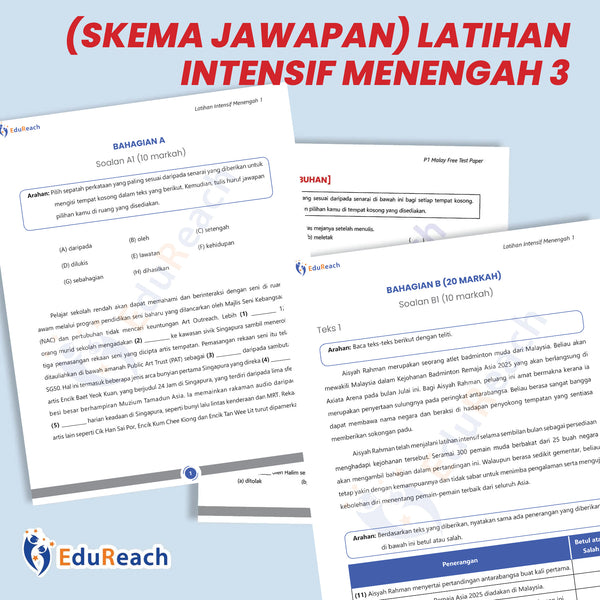
The Latihan Intensif Bahasa Melayu Menengah 3 workbook provides structured, comprehensive O-Level preparation removing guesswork from home practice.
What you get:
-
40 worksheets (20 comprehension + 20 language use)
-
Complete answer keys with detailed explanations
-
Integrated oral preparation throughout
-
O-Level format alignment
-
Systematic skill progression
-
Independent study capability
Free delivery throughout Singapore. Order today and start your serious O-Level preparation.
Consider complementing workbook practice with expert tuition at EduReach where qualified teachers provide personalized guidance, oral practice, and examination strategies while this workbook reinforces concepts through independent study.
The combination of professional instruction and systematic self-practice represents a proven pathway to O-Level success.
Secondary 3 is your preparation year. Start with the right resources and consistent commitment. Your future self will thank you when O-Level results arrive.
Browse our complete range of Secondary Malay workbooks:
-
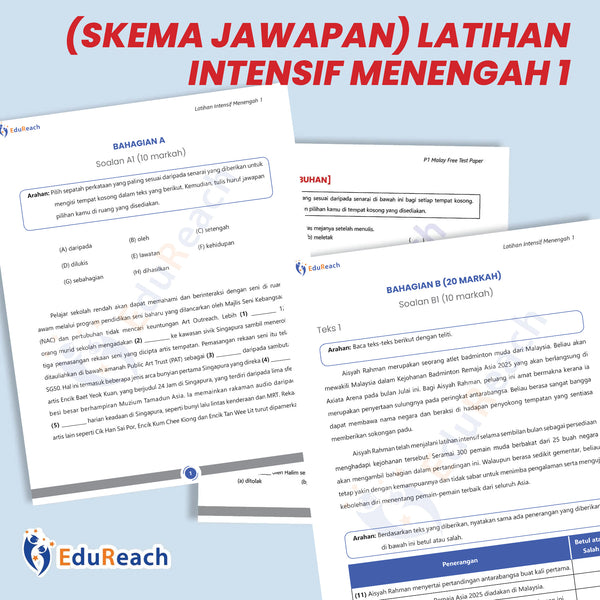
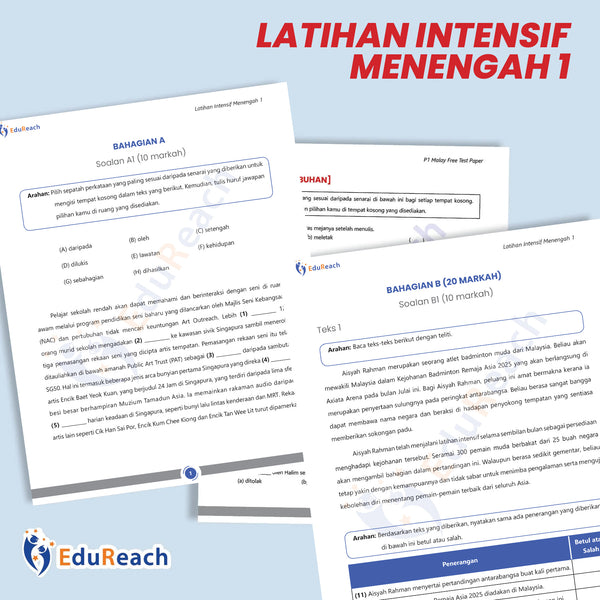
Latihan Intensif Menengah 1 - Foundation building
-
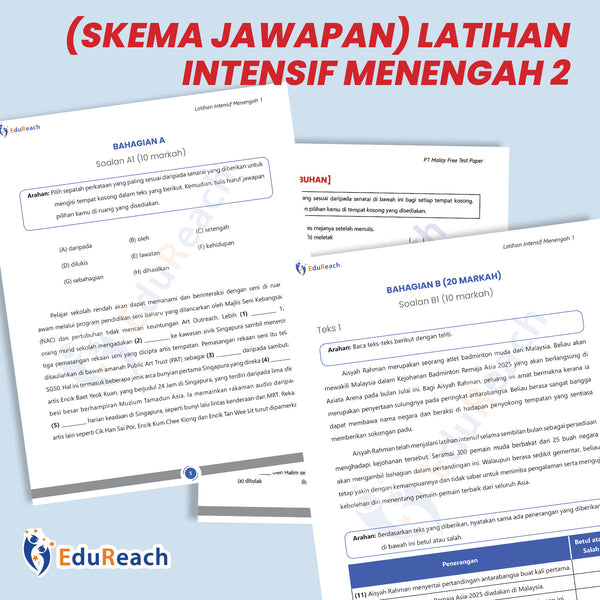
Latihan Intensif Menengah 2 - Skill development
-
Latihan Intensif Menengah 3 - O-Level preparation
-
Latihan Intensif GCE O-Level - Final examination practice
Order now. Free Singapore delivery. Start preparing today.
Try Before You Commit!
Book a FREE trial class and experience our teaching excellence firsthand.
Need Personalized Guidance?
Speak with our education consultants to find the perfect program for your child.
Join the EduReach Family Today!
Be part of Singapore's most trusted tuition center with 4 convenient locations and personalized learning programs designed for your success.
💡 Free trial class available • No obligation • Flexible schedules
📚 Essential Education Books & Resources
Enhance learning with our curated selection of English, Math, and Science materials.
(Skema Jawapan) Latihan Intensif Menengah 1
(Skema Jawapan) Latihan Intensif Menengah 2
(Skema Jawapan) Latihan Intensif Menengah 3
(Test Paper) Latihan Intensif Menengah 1
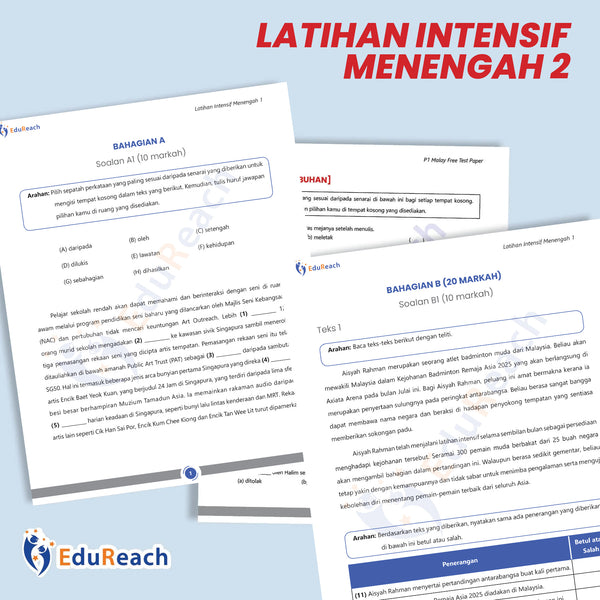
(Test Paper) Latihan Intensif Menengah 2
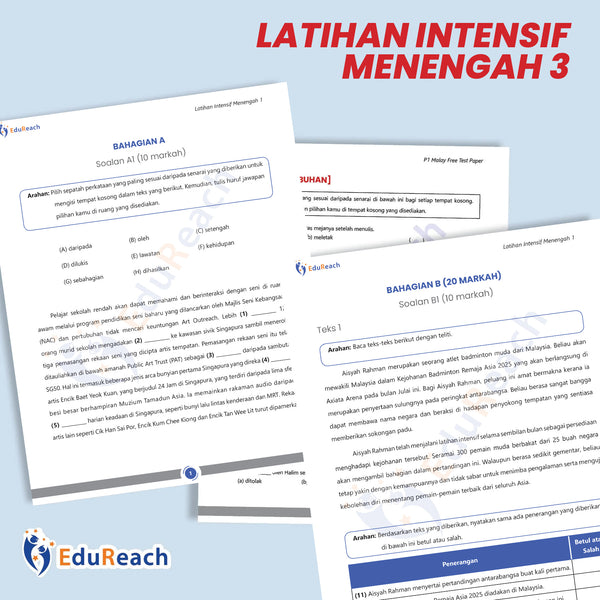
(Test Paper) Latihan Intensif Menengah 3
Kembara KidzNizmo (Edisi Khas KidzNizmo) Prasekolah 1