Latihan Intensif Menengah 1: Sec 1 Malay Workbook 2026


🎓 Ready to Excel in Your Studies?
Join thousands of students who have improved their grades with EduReach's proven teaching methods. Start your journey to academic success today!
Enroll Now via WhatsAppThe post-PSLE months feel strange. Your child just completed their biggest examination yet. Secondary school looms ahead. Everyone keeps saying "secondary school is different" but nobody explains exactly how—or how to prepare.
Here's what's actually different about Secondary 1 Malay: The passages get longer and more complex. The grammar assumes you've mastered basics and moves straight to advanced structures. Essays need mature expression, not just correct sentences. And oral exams? Those now require actual spontaneous discussion, not memorized scripts.
Many students who scored well in PSLE Malay hit unexpected bumps during Secondary 1. Not because they lost ability, but because nobody bridged the gap between primary and secondary expectations.
Latihan Intensif Bahasa Melayu Menengah 1 addresses exactly this transition challenge—providing structured practice aligned with MOE's current Secondary 1 syllabus and examination format.
Why the Primary to Secondary Malay Transition Feels Hard
PSLE prepared your child for PSLE. Secondary school operates differently.
Vocabulary expectations jump significantly. Words your child rarely encountered in primary texts now appear regularly. Passages discuss abstract concepts—societal issues, technological impacts, cultural heritage—using sophisticated terminology.
Question complexity increases. PSLE comprehension often tested literal understanding—"what happened in the story?" Secondary 1 questions ask "why did the author choose this word?" and "what can you infer about the character's motivation?"
Essay standards raise dramatically. That 150-word PSLE composition? Secondary 1 expects 250+ words with varied sentence structures, sophisticated connectors, and mature expression. Examiners no longer reward simple correctness—they assess language sophistication.
Oral examination formats change. Primary school oral had picture descriptions with simple follow-up questions. Secondary oral requires spontaneous discussion of topics you might know nothing about—expressing opinions, supporting arguments, demonstrating fluency under pressure.
School practice time decreases. Most secondary schools allocate just 2-3 periods weekly for Malay. With less classroom time, home practice becomes essential, not optional.
Students who excelled in PSLE Malay sometimes struggle initially because they're applying primary-level strategies to secondary-level demands. The strategies that worked before—memorized phrases, simple sentence patterns, basic vocabulary—no longer suffice.
This transition challenge is normal. Expecting it helps. Having the right practice materials helps more.
What's Inside Latihan Intensif Menengah 1
This workbook (priced at $20.90) provides comprehensive Secondary 1 Malay practice aligned with MOE's current syllabus and the updated 2021 examination format.
Component A1: Comprehension Practice (20 Worksheets)
Twenty progressively challenging passages with accompanying questions covering all Secondary 1 comprehension skills:
Text variety includes:
-
Narrative passages exploring character, theme, and plot development
-
Expository articles on science, technology, society, and culture
-
Persuasive texts requiring analysis of arguments and techniques
-
Mixed formats preparing students for examination unpredictability
Question types span:
-
Multiple choice testing vocabulary in context
-
Open-ended questions requiring complete sentence responses
-
Inference questions reading between lines
-
Analysis questions examining author's purpose and technique
-
Summary writing with specific word limits
Early worksheets review upper primary skills before introducing secondary-level complexity. This scaffolded progression prevents overwhelming students while ensuring appropriate challenge.
Answer keys provide complete model responses with explanations—not just correct answers but why they're correct and what makes them complete.
Component A2: Language Use & Grammar (20 Worksheets)
Systematic coverage of Secondary 1 grammar and language use components:
Core topics include:
-
Verb tenses and aspects (progressive, perfect, conditional)
-
Complex sentence structures with multiple clauses
-
Active and passive voice
-
Direct and indirect speech
-
Conjunctions and connectors for coherent writing
-
Contextual vocabulary building
-
Common idioms and proverbs
-
Error identification and correction
Exercises progress from controlled practice (with support) through semi-controlled exercises (less guidance) to free production (independent application).
This progression builds automatic language use—the difference between knowing rules theoretically and producing correct language naturally under examination pressure.
Integrated Oral Preparation (Panduan Lisan)
The oral examination component—often causing significant anxiety—receives systematic attention:
Frameworks provided for:
-
Reading aloud with proper pronunciation, intonation, and pacing
-
Picture description with systematic observation strategies
-
Conversational responses with expansion techniques
-
Opinion articulation with supporting reasoning
-
Spontaneous response strategies
Model responses at different proficiency levels help students understand performance standards. You see what distinguishes excellent oral performance from average attempts—vocabulary range, sentence complexity, idea development, natural fluency.
Practical techniques covered:
-
Organizing thoughts quickly during preparation time
-
Expanding simple answers into detailed responses
-
Buying thinking time appropriately when uncertain
-
Demonstrating vocabulary range naturally
-
Common pronunciation pitfalls for Singaporean students
The oral component typically constitutes 20-30% of Malay examination marks. This workbook's structured oral preparation makes home practice feasible despite the speaking component's inherent challenges.
Complete Answer Keys with Explanations
Every exercise includes comprehensive answer keys. Not just correct answers—detailed explanations showing:
-
Why certain answers earn full marks
-
What examiners look for in responses
-
Common errors and how to avoid them
-
Reasoning processes behind effective comprehension strategies
These detailed explanations support independent learning. Students can check their own work and understand mistakes without constant parental supervision.
Who Benefits Most from This Workbook
Express Stream Students
This workbook's exercises are calibrated to Express stream curriculum expectations and difficulty levels. Vocabulary, passage complexity, and question types match what Express students encounter in school examinations.
Normal Academic stream students may find some exercises slightly above curriculum level, though foundational components remain beneficial for capable NA students seeking additional challenge.
Students Bridging from PSLE
If your child scored AL 3-6 in PSLE Malay, this workbook provides appropriate challenge and support. The initial chapters review primary concepts while progressively introducing secondary demands.
Students who scored AL 1-2 may find early chapters somewhat basic, though later chapters and oral components offer value across proficiency levels.
Students who struggled significantly in PSLE (AL 7-8) benefit from combining this workbook with additional support from teachers or quality Malay tuition.
Self-Directed Learners
The comprehensive answer keys and explanations enable genuine independent study. Students can practice, check work, understand mistakes, and improve without constant supervision.
Parents without strong Malay language skills can still support their children effectively—the workbook's self-explanatory format reduces reliance on parental language proficiency.
Students Preparing for School Examinations
Whether preparing for mid-year assessments or year-end examinations, the 40 worksheets provide sufficient practice coverage of all major Secondary 1 topics and question types.
Building Progressive Learning Pathways
Students planning to continue with Latihan Intensif Menengah 2 and Menengah 3 benefit from consistent format and methodology across the series. Familiarity with exercise structures allows focus on increasingly complex content rather than adapting to new formats each year.
How to Use This Workbook Strategically
Establish Consistent Practice Rhythm
Recommended schedule: 30-45 minute sessions, 3 times weekly
At this pace, complete approximately one worksheet per session, finishing the entire workbook in 12-14 weeks—ideal timing for one school semester.
Optimal practice times: When your child is mentally fresh—weekend mornings, early evenings before dinner. Avoid practicing immediately after school when exhaustion reduces effectiveness.
Consistency matters more than intensity. Three moderate sessions weekly outperform one marathon weekend session. Distributed practice enhances retention through spaced repetition.
Start with Diagnostic Assessment
Before systematic practice, complete one A1 worksheet and one A2 worksheet under examination conditions (no answer key peeking while working).
Score honestly. This diagnostic reveals:
-
Current baseline performance
-
Specific strength and weakness areas
-
Which components need priority attention
If scores fall below 60%, prioritize grammar (Component A2) as weak foundations undermine all other components.
If comprehension significantly lags grammar, dedicate extra time to Component A1 passages and active reading strategies.
Practice Active Learning
For comprehension passages:
-
Read once for general understanding
-
Re-read strategically when answering questions
-
Underline key evidence phrases before formulating answers
-
Check your underlining against answer keys—did you identify the right evidence?
For grammar exercises:
-
Verbalize rules aloud before answering
-
Write brief explanations for why wrong answers are incorrect
-
Saying rules strengthens memory and understanding
After marking every worksheet:
-
Don't just note correct answers
-
Analyze WHY errors occurred
-
Were they conceptual misunderstandings? Careless mistakes? Timing issues?
-
Different error types require different solutions
Maintain an error log:
-
Record recurring mistake patterns
-
Write brief explanations of concepts
-
Revisit weak areas weekly until patterns break
Integrate Oral Practice Deliberately
The oral component requires actual speaking practice:
Record yourself: Use your phone responding to prompts. Listen critically to pronunciation, fluency, response quality. Most students are shocked hearing themselves initially—this awareness drives improvement.
Time strictly: Match examination conditions (typically 1-2 minutes per prompt). Examiners maintain tight schedules and will interrupt if you exceed time.
Practice with variety: Randomly select different prompts rather than sequential completion—simulates examination unpredictability.
Seek feedback: From Malay-speaking family members, friends, teachers, or tuition instructors who can identify specific pronunciation and fluency issues you can't self-diagnose.
Coordinate with School Learning
Use this workbook strategically alongside school curriculum:
After school chapter tests: Identify struggled topics. Complete corresponding workbook sections for targeted remediation.
Before school examinations: Systematically work through relevant worksheets as comprehensive revision, focusing especially on identified weak areas.
Coordinate with teachers: Share your practice plans. Ask for specific recommendations aligning with upcoming school assessments. Most teachers appreciate student initiative and provide helpful guidance.
Strategic Long-Term Planning
Your Four-Year Secondary Malay Roadmap
Secondary 1 begins a four-year journey toward O-Level Bahasa Melayu. Strategic planning from the start produces better outcomes than reactive scrambling later.
Secondary 1 (Foundation Building):
-
Complete Latihan Intensif Menengah 1 systematically
-
Focus on understanding concepts and building skills
-
Establish consistent practice habits
-
Address knowledge gaps early
Secondary 2 (Skill Development):
-
Progress to Latihan Intensif Menengah 2
-
Deepen comprehension analysis abilities
-
Advance composition sophistication
-
Maintain oral practice consistency
Secondary 3 (O-Level Preparation Begins):
-
Continue with Latihan Intensif Menengah 3
-
Focus on examination-specific techniques
-
Intensive weak area remediation
-
Build examination stamina
Secondary 4 (Final Preparation):
-
Complete Ten Year Series O-Level papers
-
Timed examination practice
-
Oral intensive drilling
-
Consolidation and confidence building
Beyond Workbooks: Authentic Language Exposure
Systematic workbook practice forms your foundation. Authentic language use accelerates proficiency:
Read Malay materials regularly:
-
Age-appropriate Malay novels or story collections
-
Berita Harian articles on topics interesting to teens
-
Online Malay content about hobbies or interests
Consume Malay media:
-
Suria channel programs
-
Malay language films or documentaries
-
YouTube channels in Malay covering topics your child enjoys
Practice conversational Malay:
-
Simple daily exchanges with family members
-
Community activities where Malay is spoken
-
Cultural events providing authentic language contexts
These authentic experiences make textbook learning meaningful and develop cultural competency examinations increasingly assess.
Set Realistic Expectations
Secondary 1 is an adjustment year. Some performance fluctuation is normal as students adapt to increased difficulty.
Focus on progressive improvement rather than immediate perfection. A student improving from 55% to 65% over two semesters demonstrates excellent growth, even if 65% isn't yet an A grade.
Strong foundations in Secondary 1-2 enable significant performance leaps in Secondary 3-4 when examination pressure increases motivation. The work invested now pays dividends later.
Parent Support Strategies
Many Singaporean parents feel uncertain about supporting their children's Malay learning, particularly without strong language proficiency themselves.
Create Supportive Learning Conditions
Your role isn't teaching Malay—teachers and quality resources do that. Instead, create conditions enabling effective learning:
Physical environment:
-
Quiet, distraction-free study space
-
Good lighting and comfortable seating
-
Necessary materials readily available (dictionary, highlighters, correction tape)
Expectation setting:
-
Clear agreement about regular practice schedules
-
Flexibility about specific timing while maintaining consistency
-
Understanding that learning involves mistakes and struggles
Positive engagement:
-
Show interest in progress without micromanaging
-
Occasionally ask your child to explain what they've learned
-
Celebrate effort and improvement, not just marks
Monitor that practice actually happens and workbooks are used correctly (not just copying answers), but avoid hovering over every question.
Leverage Available Resources
Technology tools:
-
Malay dictionary apps for quick vocabulary reference
-
Online pronunciation resources for oral practice support
-
Educational YouTube channels with Malay content
Community resources:
-
Parent forums exchanging strategies and experiences
-
School teacher consultations for specific guidance
-
Educational material suppliers like EduReach offering comprehensive support
When to Seek Additional Support
This workbook provides excellent self-study resources, but some situations warrant additional intervention:
-
Consistent scores below 50% despite regular practice
-
Declining school examination performance across multiple tests
-
Significant anxiety or resistance about Malay learning
-
Persistent skill gaps (especially oral) despite workbook practice
Consider structured tuition programs providing expert teacher guidance, personalized feedback, and peer interaction. Quality tuition combined with systematic workbook practice creates powerful synergy.
Common Questions About Secondary 1 Malay Workbooks
How long does completion require?
Most students finish in 10-14 weeks with consistent practice of 2-3 sessions weekly. Rushing through faster reduces effectiveness. Taking much longer risks losing momentum.
Can my child use this independently?
Yes. Comprehensive answer keys and explanations support independent learning. However, parents should periodically verify practice is happening genuinely, not just answer copying.
Does this follow current MOE syllabus?
Yes. The workbook aligns with current MOE Secondary 1 Bahasa Melayu syllabus and the updated 2021 examination format.
Should we complete this before school examinations?
Ideally, use throughout the year for systematic skill building rather than just pre-examination cramming. For examination revision, focus on sections targeting known weak areas.
Can this replace tuition?
For self-motivated students with reasonable baseline proficiency, this workbook combined with school learning may suffice. Students struggling with concepts or motivation typically benefit from structured tuition in addition to workbook practice.
Are complete answers provided?
Yes. Complete answer keys with explanations for comprehension questions and grammar exercises enable students to understand mistakes and learn from errors.
Where can I purchase this?
Available directly from EduReach Singapore at $20.90 with island-wide delivery.
Making Your Secondary 1 Learning Investment
Secondary school represents a critical academic development phase. Study habits, knowledge foundations, and confidence your child builds now significantly influence outcomes—not just in Malay but across all subjects.
Latihan Intensif Bahasa Melayu Menengah 1 provides structured, comprehensive, examination-aligned practice removing guesswork from home learning.
What you get:
-
40 worksheets (20 comprehension + 20 language use)
-
Complete answer keys with detailed explanations
-
Integrated oral preparation throughout
-
MOE syllabus alignment
-
Systematic skill progression
-
Independent learning capability
-
Updated 2021 examination format
Investment: $20.90
For families planning complete secondary support, explore the full Latihan Intensif series including Menengah 2 and Menengah 3. Consistent format and progressive difficulty across the series support continuous learning from Secondary 1 through O-Level preparation.
Consider complementing workbook practice with professional tuition at EduReach where qualified teachers provide personalized guidance, oral practice feedback, and examination strategies while this workbook reinforces concepts through independent study.
Your child's Bahasa Melayu success isn't just about examination scores—it's about developing confidence in a national language, appreciating cultural heritage, and building communication skills benefiting them throughout life.
Starting Secondary 1 with the right resources and strategies sets them on the path toward excellence.
Order Latihan Intensif Menengah 1 today. Free Singapore delivery. Start building Secondary 1 success now.
Try Before You Commit!
Book a FREE trial class and experience our teaching excellence firsthand.
Need Personalized Guidance?
Speak with our education consultants to find the perfect program for your child.
Join the EduReach Family Today!
Be part of Singapore's most trusted tuition center with 4 convenient locations and personalized learning programs designed for your success.
💡 Free trial class available • No obligation • Flexible schedules
📚 Essential Education Books & Resources
Enhance learning with our curated selection of English, Math, and Science materials.
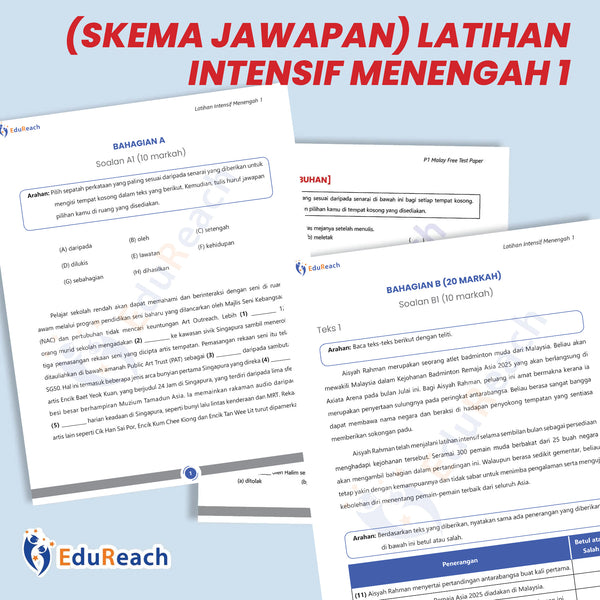
(Skema Jawapan) Latihan Intensif Menengah 1
(Skema Jawapan) Latihan Intensif Menengah 2
(Skema Jawapan) Latihan Intensif Menengah 3
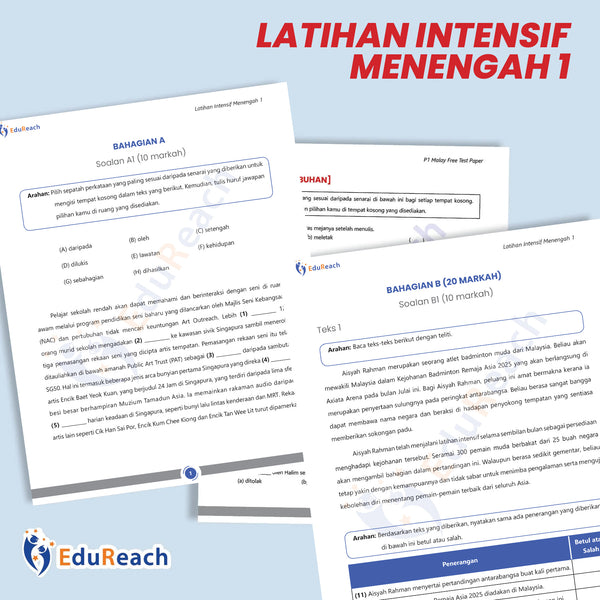
(Test Paper) Latihan Intensif Menengah 1
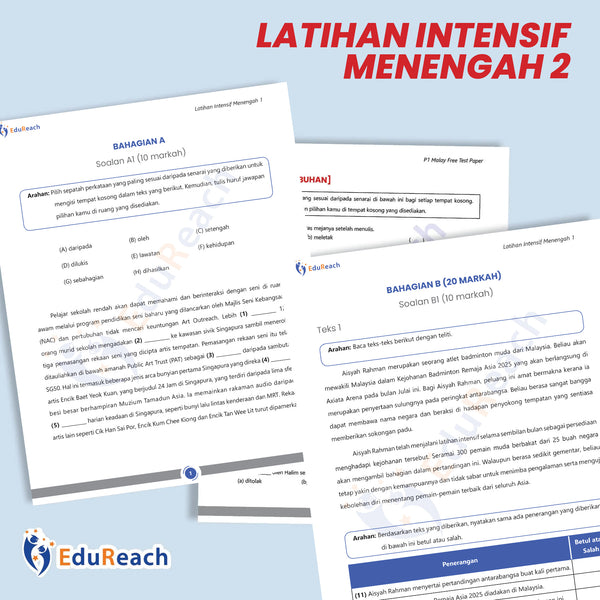
(Test Paper) Latihan Intensif Menengah 2
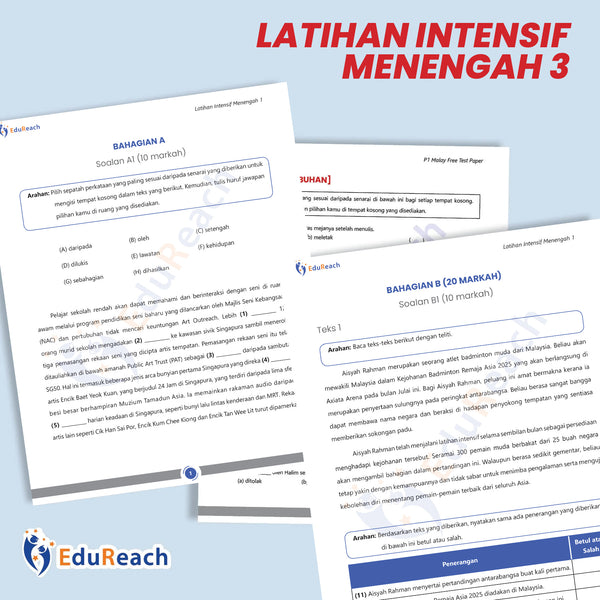
(Test Paper) Latihan Intensif Menengah 3
Kembara KidzNizmo (Edisi Khas KidzNizmo) Prasekolah 1