PSLE Malay Workbooks: Best Latihan Efektif P3–P6 Guide


🎓 Ready to Excel in Your Studies?
Join thousands of students who have improved their grades with EduReach's proven teaching methods. Start your journey to academic success today!
Enroll Now via WhatsAppFinding quality Malay language assessment books in Singapore can feel like searching for a needle in a haystack. While English and Chinese resources flood the shelves of Popular and Times bookstores, dedicated Bahasa Melayu workbooks remain surprisingly scarce—leaving many Malay parents frustrated and uncertain about how to support their children's mother tongue education.
If you're a parent watching your child struggle with karangan writing, peribahasa memorization, or kefahaman comprehension, you're not alone. The good news? The right assessment book can transform your child's confidence and performance in PSLE Bahasa Melayu. This comprehensive guide will help you understand exactly what to look for and why the Latihan Efektif series paired with Koleksi Karangan has become the go-to choice for Singapore's Malay-speaking families.
Why Malay Language Assessment Books Matter More Than Ever in 2026
The Singapore education landscape continues to emphasize bilingual proficiency, with Mother Tongue Languages (MTL) playing a crucial role in a student's overall academic profile. For Malay students, PSLE Bahasa Melayu carries significant weight—not just for primary school leaving results, but for secondary school streaming and future Higher Malay Language eligibility.
According to recent MOE announcements, from 2026, more students will be allowed to study Higher Mother Tongue from Secondary 1, making strong foundational skills even more critical. Students who demonstrate proficiency in their mother tongue at the primary level gain access to expanded opportunities throughout their educational journey.
The Unique Challenges Facing Malay Students in Singapore
Research from the Dyslexia Association of Singapore highlights a particular challenge: many Malay students in Singapore grow up in predominantly English-speaking households. This means their exposure to formal Bahasa Melayu vocabulary, sentence structures, and writing conventions is often limited to classroom hours.
Unlike their peers in Malaysia or Indonesia who are immersed in a Malay-dominant environment, Singaporean Malay children must actively cultivate their language skills through structured practice. This is precisely where high-quality assessment books become invaluable—they provide the systematic exposure and practice that home environments may not naturally offer.
Understanding the PSLE Malay Language Format 2026
Before selecting assessment books, parents must understand what their children will face during the actual examination. The PSLE Bahasa Melayu examination consists of multiple components, each requiring specific skills and preparation strategies.
PSLE Higher Malay Language (0016) Structure
Paper 1: Karangan (Composition)
-
Total marks: 40 (40% of overall grade)
-
Duration: 50 minutes
-
Format: Choose 1 question from 2 options
-
Minimum requirement: 180 words
-
Dictionary usage: Permitted
Paper 2: Penggunaan Bahasa dan Kefahaman (Language Use and Comprehension)
-
Total marks: 60 (60% of overall grade)
-
Duration: 1 hour 20 minutes
-
Components:
-
Bahagian A: Peribahasa (10 marks) + Mengedit Teks/Text Editing (10 marks)
-
Bahagian B: Kefahaman 1/Comprehension 1 (16 marks)
-
Bahagian C: Kefahaman 2/Comprehension 2 (24 marks)
-
Key Skills Tested at Each Level
The PSLE Malay examination assesses students across multiple competency areas:
| Skill Area | What's Tested | Marks Allocation |
|---|---|---|
| Peribahasa (Proverbs) | Recognition, meaning, contextual usage | 10 marks |
| Imbuhan (Affixes) | Prefix, suffix, and circumfix application | Part of editing |
| Kefahaman (Comprehension) | Literal and inferential understanding | 40 marks |
| Karangan (Composition) | Narrative writing, vocabulary, grammar | 40 marks |
| Lisan (Oral) | Pronunciation, expression, conversation | Separate component |
Understanding this structure helps parents identify which areas their children need the most support in—and select assessment books that address those specific weaknesses.
What Makes an Effective Malay Language Assessment Book?
Not all assessment books are created equal. After analyzing the top-performing resources in the Singapore market, several key characteristics distinguish truly effective Malay language workbooks from mediocre ones.
1. MOE Syllabus Alignment
The most critical factor is alignment with the current MOE Bahasa Melayu syllabus. Books that haven't been updated to reflect the latest curriculum changes will leave students practicing outdated content and formats. Look for publications that explicitly state "Selaras dengan sukatan pelajaran terkini" (Aligned with the latest syllabus).
2. Structured Topical Exercises
Effective assessment books organize content by topic rather than presenting random exercises. This topical approach allows students to master one concept before moving to the next, building a solid foundation progressively. The Primary 3 Latihan Efektif Darjah 3 + Koleksi Karangan Bundle exemplifies this approach with systematically arranged exercises that scaffold learning from basic to advanced.
3. Comprehensive Answer Keys
Parents often overlook this feature, but detailed answer keys are essential—especially for non-Malay-speaking parents or those whose own Bahasa Melayu may be rusty. Quality answer keys don't just provide correct answers; they explain why certain answers are correct, helping both parent and child understand the underlying language rules.
4. Oral Examination Guidance
Many assessment books focus exclusively on written components, neglecting the oral examination. Superior resources include "Panduan Lengkap Proses Lisan" (Complete Oral Process Guide) that helps students prepare for reading passages aloud and engaging in conversation with examiners.
5. Peribahasa Lists and Practice
Peribahasa (Malay proverbs) represent a significant challenge for many students. The best assessment books include comprehensive lists—ideally 30 or more commonly tested peribahasa—along with exercises that test understanding and application in context.
The Latihan Efektif Series: A Detailed Review
Among the various Malay assessment books available in Singapore, the Latihan Efektif series has established itself as a market leader. Let's examine what makes this series particularly effective for PSLE preparation.
Core Features of Latihan Efektif Workbooks
The Latihan Efektif Bahasa Melayu series distinguishes itself through several standout features:
Structured Learning Progression
Each workbook follows a carefully designed progression that mirrors the school year. Topics build upon each other logically, ensuring students develop skills systematically rather than haphazardly.
Exam-Style Questions
Questions are formatted to match actual PSLE examination styles. This means students become familiar with how questions are phrased and presented, reducing anxiety and improving performance on exam day.
Complete Practice Papers
Beyond topical exercises, each workbook includes full examination papers (Ujian Lengkap Kertas 2) that simulate actual testing conditions. This allows students to practice time management and experience the full examination format.
Integrated Oral Preparation
Unlike competitors that treat oral examination as an afterthought, Latihan Efektif includes comprehensive oral guidance integrated throughout the workbook.
Level-by-Level Breakdown
Primary 3 (Darjah 3)
At the Primary 3 level, students are building foundational literacy skills. The Primary 3 Latihan Efektif Bundle focuses on:
-
Basic sentence construction and grammar
-
Introduction to common peribahasa
-
Simple comprehension passages
-
Guided composition writing with picture prompts
-
Early oral communication skills
This level emphasizes building confidence and establishing good study habits. Exercises are designed to be achievable while still challenging, preventing frustration while promoting growth.
Primary 4 (Darjah 4)
Primary 4 marks a transition point where language complexity increases significantly. The Primary 4 Latihan Efektif Bundle addresses this transition by:
-
Expanding vocabulary through thematic units
-
Introducing more complex sentence structures
-
Deepening peribahasa understanding and application
-
Building independent comprehension skills
-
Developing more sophisticated composition techniques
Students at this level begin writing longer compositions and must demonstrate greater grammatical accuracy. The workbook provides extensive practice in imbuhan (affixes), which many students find challenging.
Primary 5 (Darjah 5)
Primary 5 represents a critical year—students must consolidate all previous learning while preparing for the intensity of Primary 6. The Primary 5 Latihan Efektif Bundle delivers:
-
Advanced comprehension with inferential questions
-
Extended writing practice (approaching the 180-word minimum)
-
Complex peribahasa usage in context
-
Text editing exercises matching PSLE format
-
Mock examinations for self-assessment
Parents of Primary 5 students should note that this is the ideal time to identify and address any lingering weaknesses before the PSLE year begins.
Primary 6 (Darjah 6)
The PSLE year demands intensive, focused preparation. The Primary 6 Latihan Efektif Bundle is specifically designed for examination success:
-
Full PSLE-format practice papers
-
Comprehensive peribahasa revision (30+ proverbs)
-
Advanced composition techniques and model essays
-
Intensive comprehension practice with higher-order thinking questions
-
Complete oral examination preparation guide
This level assumes students have built foundational skills and focuses on refinement, speed, and examination technique.
Koleksi Karangan: Mastering PSLE Malay Composition
Composition writing (karangan) accounts for 40% of the PSLE Malay grade, yet many students find it the most challenging component. Unlike comprehension, which tests understanding of existing text, composition requires students to generate original content—a significantly more demanding cognitive task.
Common Karangan Challenges Students Face
Limited Vocabulary
Students often know what they want to express but lack the Malay vocabulary to articulate it effectively. This leads to repetitive word choices and simplistic sentence structures.
Weak Opening Paragraphs
Many students struggle to write engaging openings that capture reader attention. They default to generic beginnings like "Pada suatu hari..." (One day...) without creating intrigue or setting a compelling scene.
Poor Plot Development
Compositions frequently suffer from rushed middle sections where events happen too quickly without sufficient detail or emotional depth.
Abrupt Endings
Students often realize they're running out of time and conclude their stories abruptly, missing opportunities for meaningful resolution or reflection.
Grammatical Errors
Errors in imbuhan usage, subject-verb agreement, and sentence structure reduce overall marks significantly.
How Koleksi Karangan Addresses These Challenges
The Koleksi Karangan component of the Latihan Efektif bundle directly addresses each of these challenges through:
Model Compositions
Students learn by example. The collection includes model compositions across various themes commonly tested in PSLE: keluarga (family), persahabatan (friendship), kejiranan (neighborhood), and situational narratives.
Vocabulary Building
Each composition is accompanied by vocabulary lists relevant to specific themes. Students expand their word banks systematically, enabling more sophisticated expression.
Structural Frameworks
Rather than leaving students to figure out composition structure on their own, Koleksi Karangan provides clear frameworks for introduction, development, climax, and resolution.
Phrase Banks
Students gain access to useful phrases for different narrative situations—expressing emotions, describing settings, creating dialogue, and building tension.
Practice Prompts
Guided practice prompts allow students to apply what they've learned from model compositions to new scenarios, building transfer skills essential for examination success.
Expert Tips for Using Assessment Books Effectively
Simply purchasing assessment books isn't enough—how parents and students use these resources determines their effectiveness. Here are research-backed strategies for maximizing learning outcomes.
Create a Consistent Practice Schedule
Sporadic practice yields sporadic results. Establish a regular schedule—ideally 20-30 minutes daily for lower primary and 45-60 minutes for upper primary students. Consistency trumps intensity; daily short sessions are more effective than weekly marathon study sessions.
Focus on Understanding, Not Just Completion
Many students rush through exercises to "finish" without genuinely engaging with the material. Encourage your child to understand why answers are correct, not just what the correct answers are. This deeper engagement builds lasting knowledge rather than temporary memorization.
Use Answer Keys as Teaching Tools
When reviewing completed exercises, don't simply mark answers right or wrong. Use answer key explanations to discuss errors and reinforce correct approaches. This transforms assessment books from testing tools into teaching tools.
Track Progress Over Time
Keep a record of scores and common error types. This data helps identify persistent weaknesses requiring additional attention. Many parents discover patterns—a child might consistently struggle with specific peribahasa or certain imbuhan types.
Simulate Examination Conditions
Periodically, have your child complete full practice papers under timed conditions. This builds examination stamina and helps identify time management issues before the actual PSLE.
Integrate Oral Practice
Don't neglect oral components. Practice reading passages aloud with your child, asking follow-up questions in Malay. Even if your own Bahasa Melayu is limited, listening to your child read and respond helps build their confidence and fluency.
Comparing Malay Assessment Books in the Singapore Market
Parents often wonder how different assessment book options compare. Here's an objective analysis of the major players in the Singapore Malay assessment book market.
| Feature | Latihan Efektif Bundle | Buku Latihan Pintar | Cambridge Primary Malay |
|---|---|---|---|
| Price Range | S$25-35 (bundle) | S$10.90-12.90 | S$11.88-14.06 |
| MOE Alignment | Yes, latest syllabus | Yes | International curriculum |
| Includes Oral Guide | Yes, comprehensive | Limited | No |
| Peribahasa List | 30+ proverbs | Basic list | Limited |
| Full Practice Papers | 4 complete sets | 2 sets | Varies |
| Composition Guide | Yes (Koleksi Karangan) | Basic | Limited |
| Answer Keys | Detailed explanations | Basic answers | Basic answers |
Why Bundled Resources Offer Better Value
While individual workbooks may appear cheaper, bundled resources like the Latihan Efektif + Koleksi Karangan combination provide superior value through:
-
Integrated learning: Workbook and composition guide are designed to complement each other
-
Consistent methodology: Students don't need to adapt to different teaching approaches
-
Comprehensive coverage: All PSLE components addressed in one package
-
Cost savings: Bundled pricing typically offers 15-20% savings over purchasing separately
Building a Complete PSLE Malay Preparation Strategy
Assessment books form one component of a comprehensive preparation strategy. Here's how to integrate them with other resources and approaches for optimal results.
School Resources
Work with your child's school Malay teacher to understand curriculum pacing and areas of emphasis. Assessment book practice should complement—not conflict with—school learning.
Tuition Considerations
For students requiring additional support, Malay language tuition can provide personalized guidance. However, tuition is most effective when students complete independent practice between sessions—making quality assessment books essential even for students with tutors.
Digital Resources
Supplement paper-based practice with digital resources. Online platforms offer interactive exercises, video lessons, and pronunciation guides that enhance traditional workbook learning.
Reading Habits
Encourage regular reading of Malay-language materials. Berita Harian (for older students), Malay children's books, and online content all contribute to vocabulary development and natural language acquisition.
Family Language Practice
Even simple practices—speaking Malay during family meals, watching Malay programs together, visiting grandparents who speak the language—reinforce learning in meaningful ways.
When to Start PSLE Preparation
A common question among parents is when PSLE preparation should begin. The answer varies by child, but general guidelines apply:
Primary 3: Establish foundations and good study habits. Focus on building confidence and enjoyment of the language. The Primary 3 bundle is ideal for introducing structured practice without overwhelming young learners.
Primary 4: Transition to more serious academic focus. Address any foundational gaps before they compound. The Primary 4 bundle bridges the gap between foundational and advanced skills.
Primary 5: Intensive preparation begins. Identify and remediate weaknesses aggressively. The Primary 5 bundle prepares students for the rigors of PSLE year.
Primary 6: Full examination mode. Focus on refinement, speed, and confidence. The Primary 6 bundle provides everything needed for PSLE success.
Starting early allows gradual skill building without the stress of last-minute cramming. Students who begin systematic preparation in Primary 3 or 4 consistently outperform those who only start intensive practice in Primary 6.
Understanding Your Child's Learning Style
Effective assessment book usage requires understanding how your individual child learns best. Consider these learning style adaptations:
Visual Learners
-
Use highlighters to mark key points in answer explanations
-
Create vocabulary flashcards from workbook word lists
-
Draw mind maps connecting related peribahasa
Auditory Learners
-
Read comprehension passages and compositions aloud
-
Discuss answers verbally before writing
-
Record and playback oral practice sessions
Kinesthetic Learners
-
Take movement breaks between exercises
-
Use physical flashcards that can be sorted and arranged
-
Act out composition scenarios before writing
Measuring Progress and Adjusting Strategies
Regular assessment helps ensure your approach is working. Look for these indicators of progress:
Positive Signs
-
Increasing scores on practice papers
-
Faster completion times with maintained accuracy
-
Growing confidence in discussing Malay topics
-
Voluntary use of new vocabulary and peribahasa
-
Improved school grades and teacher feedback
Warning Signs Requiring Strategy Adjustment
-
Persistent errors in the same skill areas
-
Decreasing motivation or resistance to practice
-
Stagnant or declining scores despite regular practice
-
Anxiety or stress around Malay language learning
-
Consistent time pressure on practice papers
If warning signs appear, consider:
-
Reducing session length while increasing frequency
-
Returning to earlier skill levels to rebuild foundations
-
Seeking additional support through tuition or school resources
-
Varying practice activities to maintain engagement
Frequently Asked Questions About Malay Assessment Books
Q: Can these assessment books help if my child attends a non-Malay-speaking household?
A: Absolutely. In fact, children from English-dominant households often benefit most from structured assessment books, as these provide the systematic Malay exposure they may not receive at home. The comprehensive answer keys also help non-Malay-speaking parents guide their children effectively.
Q: How many assessment books does my child need?
A: Quality trumps quantity. One well-designed bundle like the Latihan Efektif + Koleksi Karangan combination, used thoroughly, is more effective than multiple mediocre workbooks completed superficially. Complete one resource fully before considering additional materials.
Q: Should I purchase assessment books for every year or just the PSLE year?
A: Ideally, use level-appropriate assessment books throughout primary school. Language skills build cumulatively; gaps in earlier years compound into larger problems by Primary 6. Starting early with the Primary 3 bundle and progressing annually yields the best results.
Q: My child's school uses a different assessment book. Should I still purchase additional materials?
A: School-provided materials and independent assessment books serve complementary purposes. School resources align with teacher instruction, while additional materials provide extra practice and expose students to varied question styles. The combination strengthens overall preparation.
Q: How do I know if my child needs Malay tuition in addition to assessment books?
A: Consider tuition if: scores remain stagnant despite consistent practice, your child exhibits significant frustration or anxiety, you cannot provide guidance at home, or specific skill gaps require expert intervention. Assessment books alone are sufficient for many students, particularly with parental involvement.
Making Your Purchase Decision
Choosing the right assessment books is an investment in your child's educational success. When making your decision, consider:
-
Current skill level: Select books appropriate to your child's actual ability, not just their grade level
-
Specific weaknesses: Prioritize resources that address your child's particular challenges
-
Learning preferences: Choose formats your child will actually engage with
-
Budget: Bundle options typically offer better value than individual purchases
-
Time availability: Ensure you can commit to regular practice sessions
The Latihan Efektif + Koleksi Karangan bundle offers exceptional value by combining comprehensive workbook exercises with dedicated composition guidance—addressing the two major components of PSLE Bahasa Melayu in one integrated package.
Taking the Next Step
Your child's success in PSLE Bahasa Melayu begins with the right resources and consistent practice. The journey from Primary 3 to PSLE doesn't need to be stressful when approached systematically with quality materials.
Explore the complete range of Latihan Efektif bundles to find the right level for your child:
-
Primary 3 Bundle - Latihan Efektif Darjah 3 + Koleksi Karangan
-
Primary 4 Bundle - Latihan Efektif Darjah 4 + Koleksi Karangan
-
Primary 5 Bundle - Latihan Efektif Darjah 5 + Koleksi Karangan
-
Primary 6 Bundle - Latihan Efektif Darjah 6 + Koleksi Karangan
Every great achievement begins with the decision to try. Give your child the tools they need to excel in Bahasa Melayu—and watch their confidence and capabilities flourish.
This guide was prepared to help Singaporean Malay parents navigate the assessment book market and make informed decisions about their children's PSLE preparation. For more educational resources and guidance, visit EduReach Singapore.
Try Before You Commit!
Book a FREE trial class and experience our teaching excellence firsthand.
Need Personalized Guidance?
Speak with our education consultants to find the perfect program for your child.
Join the EduReach Family Today!
Be part of Singapore's most trusted tuition center with 4 convenient locations and personalized learning programs designed for your success.
💡 Free trial class available • No obligation • Flexible schedules
📚 Essential Education Books & Resources
Enhance learning with our curated selection of English, Math, and Science materials.
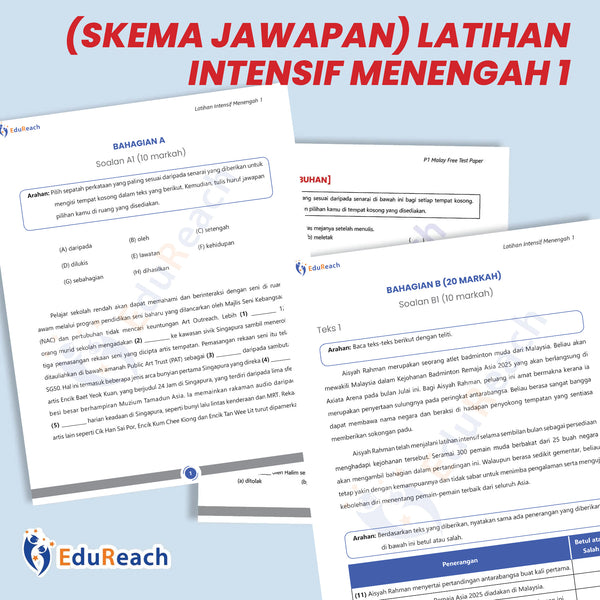
(Skema Jawapan) Latihan Intensif Menengah 1
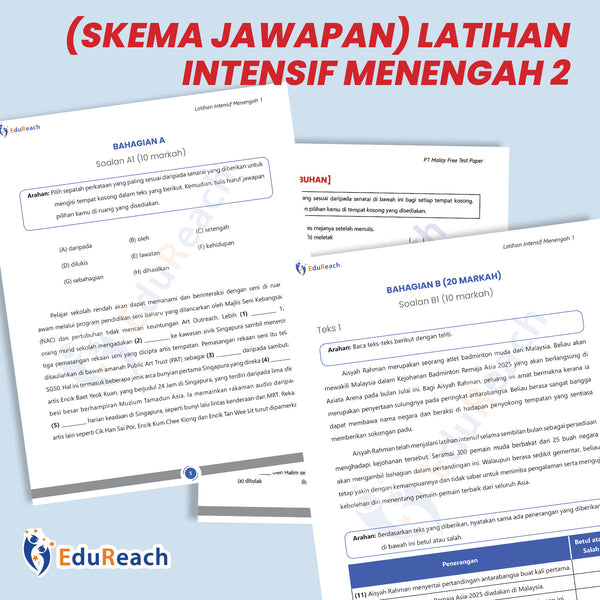
(Skema Jawapan) Latihan Intensif Menengah 2
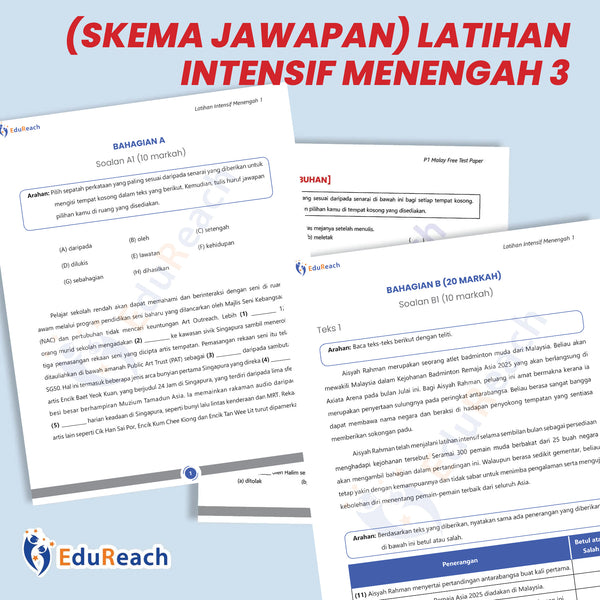
(Skema Jawapan) Latihan Intensif Menengah 3
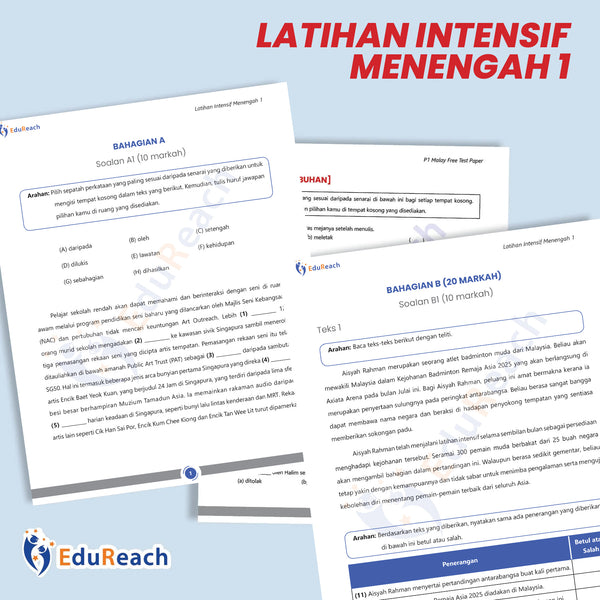
(Test Paper) Latihan Intensif Menengah 1
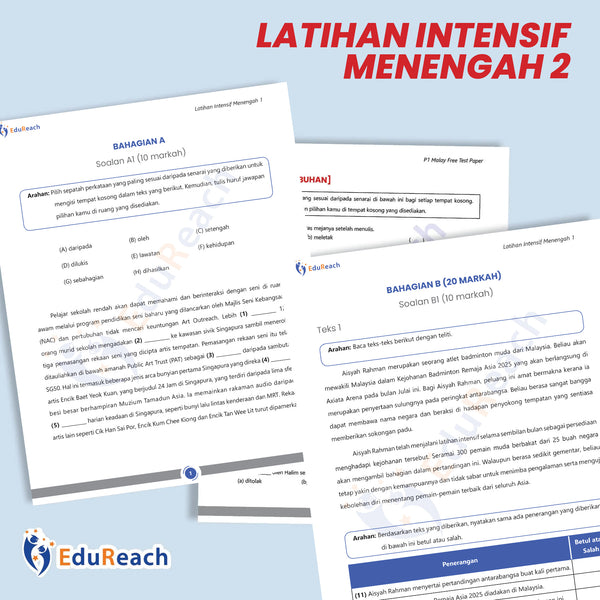
(Test Paper) Latihan Intensif Menengah 2
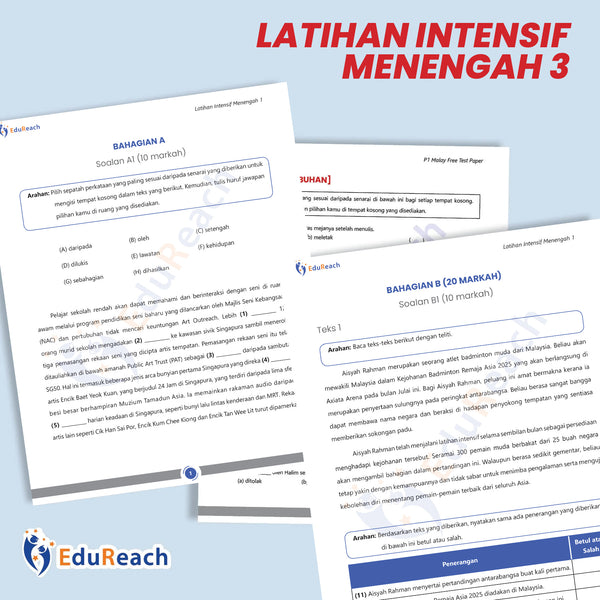
(Test Paper) Latihan Intensif Menengah 3
Kembara KidzNizmo (Edisi Khas KidzNizmo) Prasekolah 1